



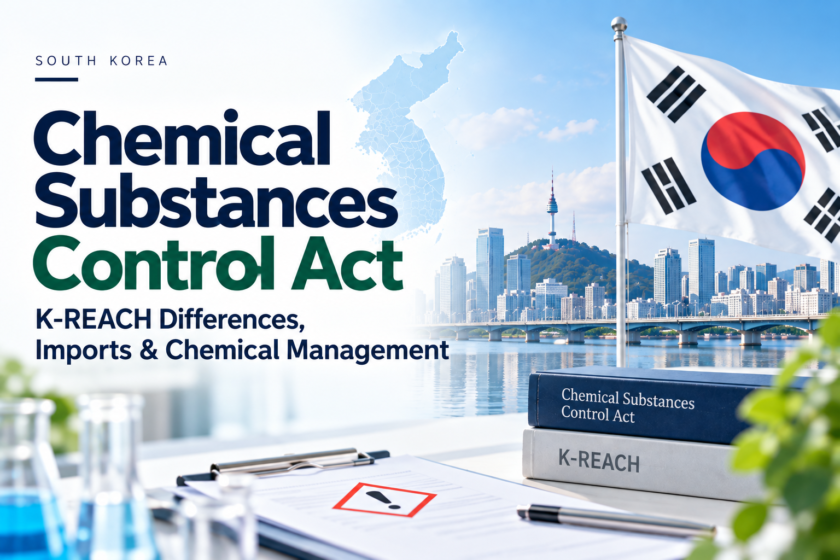
When exporting chemical products to South Korea, one of the key regulations to consider alongside K-REACH is the Chemical Substances Control Act (CSCA).
While K-REACH focuses primarily on the registration and evaluation of chemical substances, the Chemical Substances Control Act establishes requirements for the handling of chemicals in South Korea, hazardous chemical management, handling facilities, business operations and chemical accident response.
In other words, understanding South Korean chemical regulation requires companies to consider not only whether a substance has been properly registered, but also how it will be handled in South Korea.
This article explains the main differences between K-REACH and the Chemical Substances Control Act, with a focus on the points overseas companies should check when exporting chemical products to South Korea.
What Is South Korea’s Chemical Substances Control Act?
The Chemical Substances Control Act is a South Korean law designed to prevent risks to human health and the environment caused by chemical substances, ensure their appropriate management, and enable a rapid response to chemical accidents.
The Act is commonly referred to in English as the Chemical Substances Control Act (CSCA).
Its scope extends beyond the registration of chemical substances.
It establishes a broad framework for chemical management in South Korea, including chemical substance confirmation, hazardous chemical handling, labelling, storage, transportation, handling facilities, business licensing and chemical accident response.
How Is It Different from K-REACH?
K-REACH and the Chemical Substances Control Act are often discussed together, but they serve different regulatory functions.
The basic distinction can be understood as follows.
| K-REACH | Chemical Substances Control Act | |
|---|---|---|
| Primary purpose | Registration and evaluation of chemical substances | Proper chemical management and accident prevention |
| Key question | Is registration or notification required? | How must the chemical be handled? |
| Main scope | Registration of new and existing chemical substances, etc. | Hazardous chemicals, handling facilities, business operations, etc. |
| Business compliance | Registration, notification and data submission | Confirmation, labelling, storage, transport, facilities and operational management |
| Overseas company perspective | Registration status of substances exported to South Korea | Import and handling conditions in South Korea |
Although they are separate laws, the two regulatory frameworks are closely connected in practice.
For example, even if the registration or evaluation status of a substance has been confirmed under K-REACH, additional requirements may apply if the substance falls within a regulated hazardous chemical category under the Chemical Substances Control Act.
“Does this substance need to be registered or notified?”
Chemical Substances Control Act
“How must this substance be managed in South Korea?”
Chemical Substance Confirmation When Importing into South Korea
One particularly important issue for overseas companies is the confirmation process associated with the manufacture or import of chemicals into South Korea.
Under the Chemical Substances Control Act, manufacturers and importers are required to confirm whether the substances or ingredients concerned fall within relevant regulatory categories.
Depending on the product and substance, the review may involve categories such as:
- Existing chemical substances
- New chemical substances
- Hazardous chemicals
- Substances subject to priority control
- Other chemical substances subject to confirmation under applicable regulations
Therefore, preparing an SDS alone may not be sufficient when exporting a chemical product to South Korea. Companies should identify the substances contained in the product, compare them against applicable South Korean regulatory lists and determine the required procedures.
What Are “Hazardous Chemicals”?
“Hazardous chemicals” are an important concept under the Chemical Substances Control Act.
Under the regulatory framework introduced from 2025, hazardous chemicals are classified according to their hazards and management characteristics, including the following categories.
| Category | Basic Concept |
|---|---|
| Human Acute Hazardous Substances | Substances associated with concerns regarding acute effects on human health |
| Human Chronic Hazardous Substances | Substances associated with concerns regarding long-term effects on human health |
| Ecologically Hazardous Substances | Substances associated with concerns regarding environmental or ecological effects |
| Accident Preparedness Substances | Substances requiring particular preparation and response measures for chemical accidents |
The important point is that classification as a regulated substance can lead to requirements concerning labelling, storage, transportation, facility management and business operations, depending on factors such as quantity and handling conditions.
Before exporting to South Korea, companies should determine how the substance is classified under the Chemical Substances Control Act and what requirements follow from that classification.
What Changes If a Substance Is Classified as a Hazardous Chemical?
When hazardous chemicals are handled in South Korea, additional management requirements may apply depending on the quantity handled and the nature of the business.
Labelling and Information
Containers and packaging may be subject to labelling requirements under the applicable regulations.
Storage and Transportation
Hazardous chemicals are subject to applicable management standards for storage and transportation.
Handling Facilities
Depending on the facility and applicable conditions, installation, management and inspection requirements may apply.
Business Operations
Businesses engaged in the manufacture, sale, storage, transportation or use of hazardous chemicals may be subject to licensing, notification or other requirements depending on their activities and applicable conditions.
Chemical Accident Response
Depending on the substance and quantities handled, accident prevention and emergency response measures may also be required.
The required measures depend on factors such as the substance category, concentration, quantity handled, use, facility and type of business operation.
Not All Products Are Regulated in the Same Way
The Chemical Substances Control Act contains provisions concerning its scope of application, and products or substances managed under other legislation may be treated differently.
For example, pharmaceuticals, cosmetics, pesticides, food and food additives, fertilizers, feed and medical devices may require consideration of their respective sector-specific legislation.
The first step is to determine the regulatory status of the product itself.
What Should Overseas Companies Check Before Exporting?
For chemical products exported to South Korea, it is useful to consider K-REACH and the Chemical Substances Control Act as connected parts of the overall compliance process rather than as completely separate issues.
STEP 1 — Identify the Product and Substances
Organize information such as CAS numbers, substance names, composition and concentrations.
STEP 2 — Check Registration and Notification under K-REACH
Confirm whether the substances are new or existing chemicals, the annual import volume, and their registration or notification status.
What Is K-REACH? — Chemical Registration, Notification and the 2027 Registration Deadline in South Korea [2026 Edition]
STEP 3 — Check the Classification under the Chemical Substances Control Act
Determine whether the substance falls within a hazardous chemical or other applicable regulatory category.
STEP 4 — Check Handling Conditions in South Korea
Review how the chemical will be stored, transported, used or sold, and whether relevant handling facilities are involved.
STEP 5 — Organize the Required Procedures
Consider the K-REACH registration or notification requirements together with the confirmation and management requirements under the Chemical Substances Control Act, and determine the necessary compliance actions.
Following this sequence makes it easier to understand the overall structure of South Korean chemical regulatory compliance.
When dealing with South Korean chemical regulations, companies should not assume that compliance is complete once K-REACH has been addressed.
K-REACH primarily concerns registration and notification.
The Chemical Substances Control Act primarily concerns how chemicals are handled and managed in South Korea, including after import.
A practical compliance sequence is therefore:
↓
Check registration and notification under K-REACH
↓
Check the classification under the Chemical Substances Control Act
↓
Confirm handling conditions in South Korea
TICnology Japan supports companies in organizing information such as the substances involved, composition, annual export volumes, uses and handling conditions in South Korea, and in comparing suitable compliance approaches and service providers for K-REACH, the Chemical Substances Control Act, and any necessary testing or regulatory assessment.
For chemical products exported to South Korea, TICnology Japan can help organize relevant substance information, composition, annual export volumes and uses, and support the comparison of suitable approaches and service providers for K-REACH, the Chemical Substances Control Act, and any necessary regulatory assessment or testing.
Korean National Law Information Center, Chemical Substances Control Act
Korean National Law Information Center, Enforcement Decree of the Chemical Substances Control Act
Korean National Law Information Center, Enforcement Rule of the Chemical Substances Control Act
Korean National Law Information Center, Act on Registration and Evaluation of Chemical Substances
Information reviewed as of October 8, 2026.
This article provides general information on South Korea’s Chemical Substances Control Act and related chemical regulations and does not constitute legal advice for any individual case. Companies should confirm the latest legislation, official notices, regulatory guidance and applicable transaction conditions before taking compliance action.



コメント