



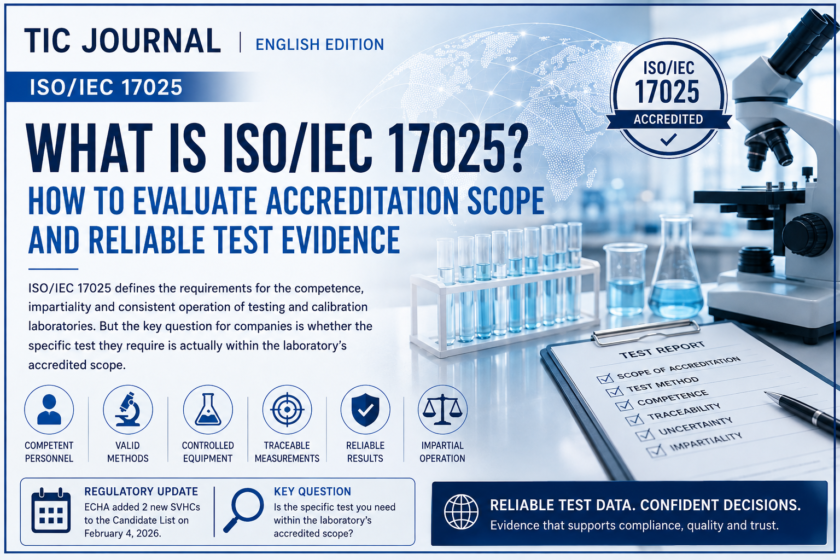
ISO / IEC 17025
Test data is an important form of evidence supporting corporate decisions on product safety, quality and compliance with environmental regulations. However, the reputation of a testing laboratory alone does not establish the technical reliability of every individual test result it produces.
ISO/IEC 17025 is the international standard that establishes requirements for the competence, impartiality and consistent operation of testing and calibration laboratories.
This article explains what ISO/IEC 17025 evaluates, how companies should examine a laboratory’s scope of accreditation, and how testing laboratories should be assessed in fields that continue to evolve—such as the Candidate List of substances of very high concern (SVHC) under the EU REACH Regulation.
EVIDENCE
1. Test Results Are “Evidence” Supporting Corporate Activities
In manufacturing, test results are more than analytical values.
They are used as a basis for corporate decisions in many situations, including compliance with chemical regulations such as the REACH Regulation and RoHS Directive, confirmation of product specifications, quality explanations to customers, research and development, failure analysis, communication with regulatory authorities and supply chain management.
When a company commissions a testing laboratory, what it ultimately needs is not simply the operation of analytical equipment.
It needs test data that can be reasonably explained to customers, business partners, regulatory authorities and internal quality assurance functions.
The important question is therefore not only whether a numerical result has been obtained, but under what conditions of competence, methodology, equipment control and quality management that result was produced.
QUESTIONS BEHIND RELIABLE TEST DATA
- Is the test method appropriate for its intended purpose?
- Does the personnel performing the test have the necessary competence?
- Is the measurement equipment appropriately controlled?
- Are samples correctly collected, stored and prepared?
- Is the validity of the result appropriately monitored?
- Can the records be traced retrospectively?
- Is there a system to protect results from commercial interests or external pressure?
ISO/IEC 17025 provides the international framework for evaluating whether a laboratory has the competence and systems required to consistently produce valid results under these conditions.
STANDARD
2. What Is ISO/IEC 17025?
The formal title of ISO/IEC 17025 is “General requirements for the competence of testing and calibration laboratories.”
It is an international standard jointly developed by ISO and IEC. The current edition is ISO/IEC 17025:2017.
The third edition was published in November 2017 and was reviewed and confirmed in 2023, meaning that the 2017 edition remains current.
ISO describes the standard as establishing requirements for the competence, impartiality and consistent operation of laboratories.
COMPETENCE
Technical Capability
The laboratory has the technical capability required to properly perform specific tests or calibrations.
IMPARTIALITY
Objective Operation
Activities are conducted objectively and are not improperly influenced by commercial interests or external pressure.
CONSISTENT OPERATION
Reliable Processes
Systems are operated consistently so that valid results can continue to be produced.
ISO/IEC 17025 is not a standard that simply confirms that a laboratory has equipment or documented procedures.
It evaluates whether competent personnel can use controlled equipment and facilities, apply valid methods, and appropriately review, record and report results.
Key Elements Covered by ISO/IEC 17025
The requirements of ISO/IEC 17025 cover general requirements relating to impartiality and confidentiality, structural requirements, resources, testing and calibration processes, and management systems.
From the perspective of a company selecting a testing laboratory, the following elements are particularly important.
Personnel Competence
Laboratories are required to define the education, training, skills, knowledge and experience necessary for personnel and to confirm their competence according to the activities they perform.
Even when the same analytical instrument is used, valid results cannot be expected without appropriate knowledge of sample preparation, measurement conditions, interfering substances and the evaluation of anomalous results.
Facilities and Environmental Conditions
Where temperature, humidity, vibration, dust, electromagnetic effects, cross-contamination or other environmental conditions can affect results, those conditions need to be appropriately controlled.
The measurement environment can directly influence results, particularly in fields such as trace analysis, dimensional measurement, microbiological testing and calibration.
Equipment Control
Measurement instruments and testing equipment need to have performance appropriate for their intended use and, where necessary, be calibrated, inspected, maintained and checked for performance.
Owning expensive or advanced analytical equipment is not the same as having the capability to consistently produce reliable results.
Metrological Traceability
Metrological traceability is the concept of relating a measurement result to an appropriate metrological reference through a documented, unbroken chain of calibrations.
A clearly established measurement reference is also important when comparing results obtained at different times or by different laboratories.
Selection, Verification and Validation of Methods
A laboratory needs to select methods appropriate for the intended purpose and confirm that it can properly perform those methods.
When a standardized or officially recognized method is introduced, the laboratory verifies that the method can be appropriately implemented using its own personnel, equipment and environment.
For laboratory-developed methods, non-standard methods or modified methods, validation is required to demonstrate that the method is suitable for its intended use.
Measurement Uncertainty
Quantitative measurement results contain sources of variation arising from factors such as equipment, reference materials, environmental conditions, sample preparation and personnel.
Particularly when a result is close to a regulatory or specification limit, measurement uncertainty and the decision rule applied can affect the determination of conformity or nonconformity.
Ensuring the Validity of Results
A laboratory does not simply perform measurements and issue reports. It also needs to continuously monitor the validity of its results.
Typical tools include reference materials, quality-control samples, blanks, replicate testing, proficiency testing and interlaboratory comparisons.
Impartiality and Confidentiality
A laboratory needs mechanisms to prevent test results from being improperly influenced by customers, sales functions, affiliated companies or other commercial interests.
It must also appropriately protect information received from customers, including samples, formulations, drawings, development information and test results.
WHAT ISO/IEC 17025 DOES — AND DOES NOT — MEAN
ISO/IEC 17025 does not guarantee that every individual result is absolutely correct. It provides a framework for third-party evaluation of whether a laboratory has the competence and systems necessary to consistently produce valid results.
COMPARISON
3. How Is ISO/IEC 17025 Different From ISO 9001?
ISO/IEC 17025 is sometimes confused with ISO 9001. Both are international standards related to quality, but their objectives and areas of evaluation are different.
| Item | ISO 9001 | ISO/IEC 17025 |
|---|---|---|
| Primary Target | Organizations across industries | Testing and calibration laboratories |
| Primary Purpose | Establishing, maintaining and improving a quality management system | Confirming competence, impartiality and consistent operation in testing and calibration |
| Main Evaluation Focus | Organization-wide processes and quality management | Testing and calibration activities and the technical and operational systems supporting them |
| Personnel Competence | Competence required for assigned work is managed | Specific competence is managed for testing and calibration activities |
| Test Methods | Not designed to directly evaluate the technical validity of individual test methods | Requires method selection, verification and validation as applicable |
| Equipment & Measurement Resources | Managed as necessary for conformity of products and services | Technically controlled according to their influence on results |
| Metrological Traceability | Measurement resources are managed where necessary | Addressed as a technical requirement according to testing or calibration activities |
| Measurement Uncertainty | Not a standard for universally evaluating uncertainty of individual test results | Evaluated as applicable to testing and calibration activities |
| Typical Third-Party Evaluation | Management system certification | Laboratory accreditation |
| Primarily Demonstrates | A system for consistently managing organizational quality | Technical competence to perform specified testing or calibration activities |
ISO 9001 establishes requirements for organizations to establish, maintain and continually improve a quality management system.
ISO/IEC 17025 focuses on the technical competence and operation involved in producing testing and calibration results.
Therefore, even if a testing laboratory is certified to ISO 9001, that certification alone does not mean that its technical competence for individual test methods has been independently evaluated.
The two standards should not be viewed as competing alternatives. They support quality from different perspectives: one focuses on organization-wide quality management, while the other focuses on technical competence in testing and calibration.
ISO 9001 STATUS — SEPTEMBER 2026
As of September 3, 2026, ISO 9001:2015 remains the published edition currently being replaced. The sixth edition of ISO 9001 is under publication and is expected to replace ISO 9001:2015 in September 2026. The comparison above is therefore based on ISO 9001:2015.
ACCREDITATION
4. What Does “ISO/IEC 17025 Accredited” Actually Mean?
For ISO/IEC 17025, the appropriate concept is generally accreditation rather than certification.
Accreditation bodies use ISO/IEC 17025 as a basis for assessing testing and calibration laboratories and evaluating whether they are competent to perform specified testing or calibration activities.
An important distinction is that a laboratory’s statement that it “complies with ISO/IEC 17025” is not necessarily the same as formal accreditation by an independent accreditation body.
The term “compliant” may be used to indicate that a laboratory operates with reference to ISO/IEC 17025. That statement alone does not necessarily demonstrate that its technical competence has been independently assessed.
Where third-party assurance is required, companies should verify:
- Whether the laboratory holds formal accreditation
- Whether the accreditation is currently valid
- Whether the specific test being commissioned is included within the accredited scope
SCOPE
5. The Most Important Question Is the Scope of Accreditation
One of the most important points to check when evaluating ISO/IEC 17025 accreditation is the laboratory’s Scope of Accreditation.
Accreditation is not automatically granted to every activity performed by a laboratory.
Competence is recognized for defined testing or calibration activities, which may be specified according to methods, items, materials, measurement ranges and locations.
Information commonly relevant to the accredited scope includes:
- Test or calibration object
- Test or measurement item
- Test method or standard number
- Applicable material or product
- Measurement range
- Facility or location where the activity is performed
For example, even if a laboratory holds ISO/IEC 17025 accreditation, this does not necessarily mean that every ICP-MS analysis, GC-MS analysis, tensile test or weathering test it performs is within its accredited scope.
Even where the same type of analytical equipment is used, differences in the target material, measurand, test method or testing location can place an activity outside the accredited scope.
KEY QUESTION
Is the specific test being commissioned within the accredited scope—including the relevant object, method, parameter, measurement range and testing location?
The question companies need to ask is therefore not merely:
“Is this laboratory ISO/IEC 17025 accredited?”
They also need to ask:
“Is the test we are commissioning actually within its accredited scope?”
Accredited and non-accredited activities may sometimes appear within the same quotation or test report.
Companies should therefore confirm the distinction when commissioning the work.
REGULATORY UPDATE
6. For REACH SVHC Testing, Also Look at How the Accreditation Scope Is Updated
In environmental regulatory testing, a laboratory cannot always be evaluated solely on the basis of its current scope of accreditation.
A representative example is the Candidate List of substances of very high concern (SVHC) under the EU REACH Regulation.
Under Article 59 of REACH, the European Chemicals Agency (ECHA) publishes and updates the Candidate List of substances that may ultimately become subject to authorisation.
Inclusion on the Candidate List can trigger obligations under provisions including Articles 7, 31 and 33 of REACH.
On February 4, 2026, two substances were added to the Candidate List. ECHA’s decision also specifies that the Candidate List was updated on that date.
However, the scope of an ISO/IEC 17025 accreditation does not automatically change on the same day that a new substance becomes subject to regulatory requirements.
To add a new substance or method to an accredited scope, a laboratory generally needs to introduce the method, complete the necessary verification or validation and quality-control preparations, and then undergo the assessment required to extend its accreditation scope.
A time gap can therefore arise between the date on which a substance is added for regulatory purposes and the date on which it is reflected in a laboratory’s accredited scope.
IMPORTANT
The fact that a newly added substance is not yet explicitly shown within a laboratory’s accredited scope does not, by itself, prove that the laboratory lacks the technical capability to analyse it.
When evaluating a laboratory for long-term use in a regulatory field that continues to evolve, the following points can provide useful evidence.
- Has the laboratory obtained accreditation coverage for substances added in previous Candidate List updates?
- Has it continuously expanded its accredited scope as new substances have been introduced?
- Does it plan to extend its accredited scope to the latest additions?
- Before accreditation is obtained, how are the method and the quality of the resulting data verified and controlled?
- Does the test report clearly distinguish results that are within the accredited scope from those that are outside it?
A laboratory that has continuously expanded its accredited scope to cover previous additions may have an established system for responding to regulatory change.
However, a history of obtaining accreditation does not guarantee that future additions will also be accredited.
TICnology Japan considers the history of scope updates to be one of several useful indicators for evaluating a laboratory’s willingness and operational capability to respond to newly regulated items.
It is also important to note that the way an accreditation scope is expressed varies by accreditation scheme, testing field and test method.
In some cases, individual substances are listed. In others, accreditation may be expressed by analytical method or by a broader group of target substances.
Companies should therefore not judge the scope merely by whether a specific substance name appears in the document. The accreditation certificate and the detailed scope should be confirmed directly with the laboratory.
FIT FOR PURPOSE
7. Even Within the Accredited Scope, Confirm Whether the Test Is Fit for Purpose
ISO/IEC 17025 accreditation is important, but a test does not automatically become suitable for every purpose simply because it falls within an accredited scope.
Even when the same substance is being measured, the meaning and usability of the result can differ depending on conditions such as:
- Target material
- Sample collection method
- Sample preparation, extraction or digestion method
- Chemical form or species being measured
- Analytical instrument used
- Limit of quantification
- Applicable standard or official test method
- Decision rule for conformity or nonconformity
Example: Chromium Analysis
Even when a request is described simply as “chromium testing,” total chromium and hexavalent chromium are different measurands.
A total chromium result alone cannot be used to directly determine conformity with a requirement specifically addressing hexavalent chromium.
Example: PFAS Analysis
The information obtained and the intended use differ between methods that individually quantify specified PFAS, screening approaches based on parameters such as total organic fluorine, and methods designed to investigate a broader range of target substances.
Companies therefore need to confirm two separate questions:
1. Accreditation
Is the requested test included within the laboratory’s ISO/IEC 17025 accredited scope?
2. Fitness for Purpose
Is the selected test method appropriate for the particular regulation, customer requirement or quality decision involved?
These questions are related, but they are not the same.
CHECK POINTS
8. What Companies Should Check When Selecting a Testing Laboratory
When selecting a testing laboratory, companies should evaluate more than price or brand recognition.
At a minimum, the following points should be checked.
1. Formal Accreditation
Do not rely only on wording such as “ISO/IEC 17025 compliant.” Confirm whether the laboratory has received formal accreditation from an independent accreditation body.
2. Scope of Accreditation
Confirm that the relevant object, parameter, method, measurement range and testing location are included within the accredited scope.
3. Status of Scope Updates
In fields where regulations are continuously updated, check whether the laboratory has continued to expand its scope to cover previous additions.
If the latest item has not yet been accredited, it can be useful to confirm whether an extension is planned, the status of any assessment process, and how the test method has been verified.
4. Suitability of the Test Method
Confirm that the method is suitable for the relevant regulation, official method, customer specification or product standard.
5. Limit of Quantification and Measurement Range
Confirm that the test provides a limit of quantification and measurement range sufficient to evaluate the applicable regulatory limit or customer criterion.
6. Expertise in the Target Material
Appropriate sample preparation and management of interfering substances differ depending on whether the material is a resin, metal, coating, electronic component, food product or another matrix.
Experience and expertise with the target material can therefore be as important as experience with the analytical parameter itself.
7. Content of the Test Report
Confirm that the report contains the information required for the intended purpose, such as the test method, result, unit, limit of quantification, sample identification and a clear distinction between accredited and non-accredited activities where applicable.
8. Technical Consultation and Change Management
It is also important to assess whether the laboratory can provide appropriate explanations and recommendations when regulations, test standards or materials change.
TOTAL COST OF TESTING
A low test price does not necessarily mean a lower overall cost. If an inappropriate method or insufficient report is discovered later, the company may face retesting, delays and the need to explain the result to customers again.
Testing laboratories should therefore be evaluated comprehensively in terms of price, lead time, technical competence, accreditation scope, specialization and regulatory responsiveness.
TICNOLOGY JAPAN VIEW
Look Beyond the Brand and Examine the Conditions That Make the Evidence Reliable
Large testing organizations can offer advantages such as extensive laboratory networks, multilingual support, broad service portfolios and a stable business infrastructure.
At the same time, a smaller specialist laboratory may possess deep expertise in a particular material or test and hold an appropriate accredited scope for that activity.
There are therefore limits to evaluating the value of a test result solely on the basis of a laboratory’s brand recognition or corporate scale.
The principal conditions supporting reliable test evidence include:
- Formal accreditation to ISO/IEC 17025
- An appropriate accredited scope covering the test being commissioned
- A test method that is fit for the intended purpose
- Technical expertise in the target material
- The ability to continuously respond to regulatory updates
In fields such as SVHC testing, where substances continue to be added over time, the question is not only whether the newest item is already included within the accredited scope.
A laboratory’s history of continuously extending its accreditation to previous additions can also provide insight into how it manages regulatory change.
Accreditation is not something that ends once it has been obtained.
As markets, regulations and testing technologies evolve, laboratories need to maintain their competence and update their accredited scopes where necessary.
TICnology Japan believes that, rather than simply selecting a laboratory brand, companies should first define the conditions required for the evidence they need and then select the laboratory and test method that satisfy those conditions.
CONCLUSION
Conclusion
ISO/IEC 17025 is an international standard addressing the competence, impartiality and consistent operation of testing and calibration laboratories.
Its scope goes far beyond laboratory equipment.
It addresses the overall system through which test results are produced, including personnel competence, test methods, facility conditions, metrological traceability, measurement uncertainty, monitoring of result validity, impartiality, confidentiality and records management.
However, accreditation is not automatically granted to every activity performed by an accredited laboratory.
Companies need to confirm whether the specific test they intend to commission is included within the laboratory’s accredited scope.
In areas such as the REACH Candidate List, where regulatory targets are periodically updated, there can also be a time gap between a regulatory addition and its inclusion within an accredited scope.
For this reason, it is important to look not only at whether the newest item appears in the current scope, but also at the laboratory’s record of responding to previous additions and its approach to future scope extensions.
The value of a test result is not determined by the name recognition of the testing organization alone.
Under what competence, method, accredited scope and quality-control system was the result produced?
Confirming these conditions is the first step toward selecting reliable test evidence.
ARTICLE INFORMATION
About This Article
This article organizes and analyses the fundamental concepts of ISO/IEC 17025 and practical considerations for selecting testing laboratories, based on publicly available information from the International Organization for Standardization (ISO) and the European Chemicals Agency (ECHA).
ISO/IEC 17025 accreditation does not universally guarantee compliance with individual regulations, customer specifications or product certification schemes, nor does it guarantee that a particular test report will be accepted for every purpose.
For individual projects, companies need to confirm the accredited scope, test method, target material, limit of quantification, applicable regulation and customer requirements.
The discussion regarding extension of accreditation scopes following additions to the SVHC Candidate List includes analysis and observations by TICnology Japan.
A laboratory’s previous record of obtaining accreditation does not guarantee that future accreditation extensions will be obtained.
This article does not recommend any particular testing laboratory, accreditation body or service.
Original information reference date: August 3, 2026
SOURCES & REFERENCES
Sources & References
Original Japanese Edition
TIC Journal — ISO/IEC 17025: Accreditation Scope and Reliable Test Evidence
Primary reference materials:
- International Organization for Standardization — ISO/IEC 17025:2017, General requirements for the competence of testing and calibration laboratories
- International Organization for Standardization — ISO 9001:2015, Quality management systems — Requirements
- International Organization for Standardization — ISO 9001:2015/Amd 1:2024, Climate action changes
- International Organization for Standardization — ISO 9001, next edition under publication
- European Chemicals Agency — Candidate List of substances of very high concern for Authorisation
- European Chemicals Agency — Decision D(2025)7771-DC, Inclusion of substances of very high concern in the Candidate List
This English Edition is a faithful international localization of the original TIC Journal article published by TICnology Japan. The structure, technical interpretation and analytical perspective of the Japanese Edition have been maintained.
TICNOLOGY JAPAN
Turning TIC Knowledge Into Business Strategy
TICnology Japan provides insight into Testing, Inspection and Certification, connecting technical competence, regulation, quality and conformity assessment with practical corporate decision-making.




コメント