


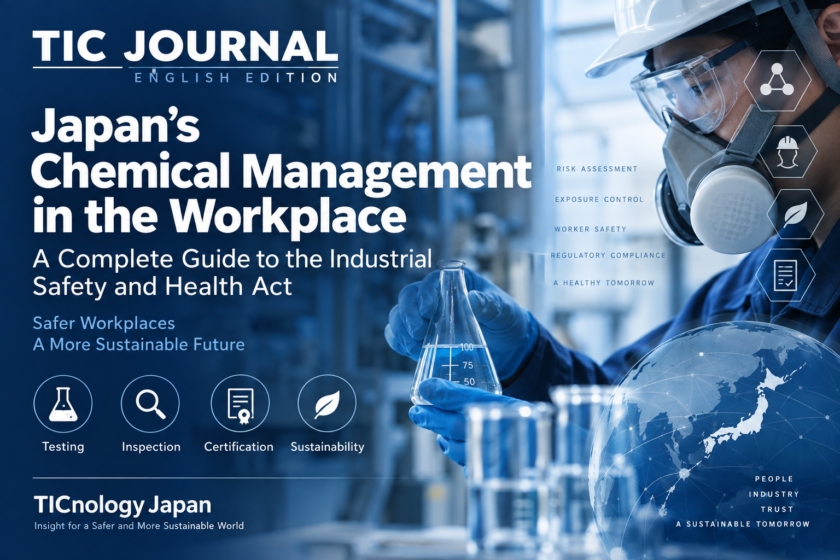
JAPAN OCCUPATIONAL SAFETY & HEALTH
In 2026, workplace chemical management in Japan is in the middle of a major transition.
The scope of substances subject to requirements such as labeling, SDS provision and risk assessment under Japan’s Industrial Safety and Health Act has been progressively expanded, reaching approximately 2,900 substances in April 2026.
But the real significance of this reform is not simply that the number of regulated substances has increased.
For many years, Japan’s chemical safety system relied heavily on an approach in which the government prescribed specific control measures for particularly hazardous chemical substances.
The system is now shifting toward autonomous chemical management, in which companies themselves use hazard information from sources such as SDSs, examine actual working conditions, assess risks, and take measures to reduce worker exposure based on the results.
To understand chemical management under the Industrial Safety and Health Act, it is therefore necessary to look beyond the question of “which substances are regulated?” and first understand the distinction between Hazard and Risk.
BASIC CONCEPT
1. What Is the Industrial Safety and Health Act? — A Law Designed to Protect Workers
Japan’s Industrial Safety and Health Act was enacted in 1972.
Its purpose is to secure the safety and health of workers in the workplace and to promote the creation of comfortable working environments.
Its scope is not limited to chemical substances.
The Act covers a wide range of occupational safety and health issues, including machinery, equipment, work procedures, falls, explosions, noise and health management.
Within that broader framework, one major area is the prevention of occupational accidents and health disorders caused by chemical substances.
Chemicals are used in many kinds of workplaces, including factories, laboratories, construction sites, maintenance operations, printing, painting and cleaning.
KEY ELEMENTS
- Labeling
- Communication through SDSs
- Risk assessment
- Exposure reduction measures
Through these mechanisms, the Industrial Safety and Health Act is intended to protect the people who actually handle chemicals in the workplace.
WHY THE SYSTEM CHANGED
2. Why Did Japan Change Its Approach to Chemical Management?
For many years, Japan established specific control measures through individual regulations for chemicals considered particularly hazardous.
SPECIAL RULE
Ordinance on Prevention of Hazards Due to Specified Chemical Substances
This ordinance sets specific requirements for certain high-risk chemical substances, including requirements relating to equipment, ventilation, measurement and health examinations.
SPECIAL RULE
Ordinance on Prevention of Organic Solvent Poisoning
This ordinance establishes specific controls for workplaces and equipment in order to prevent poisoning and health disorders caused by organic solvents.
These regulations remain important and continue to apply today.
However, the number of chemicals used in industry is extremely large, and it is not realistic for the government to establish detailed individual rules for every substance.
Moreover, occupational accidents involving chemical substances do not occur only with chemicals that are specifically regulated under rules such as those for specified chemical substances and organic solvents.
WHY REFORM WAS NEEDED
According to Japan’s Ministry of Health, Labour and Welfare, approximately 80% of chemical-related occupational accidents resulting in four or more days of absence were caused by substances that were not covered by the special regulations.
In other words, it was no longer sufficient to assume that workplaces would be safe simply by complying with rules for substances individually designated by the government.
AUTONOMOUS MANAGEMENT
3. From Prescriptive Regulation to Autonomous Chemical Management
Japan therefore began to fundamentally change the direction of its workplace chemical management system.
CONVENTIONAL APPROACH
The government designates the substance
↓
The government determines the control measures
↓
The company implements the prescribed measures
NEW APPROACH
Review hazard information
↓
Examine actual working conditions
↓
Conduct a risk assessment
↓
Select appropriate risk reduction measures
↓
Verify the results and improve the controls
This is the concept of autonomous chemical management.
It does not mean that companies are free to manage chemicals however they wish.
Companies must continue to comply with legal requirements and government standards, while also managing chemicals according to the actual substances, equipment, work methods, quantities used and working time in their own workplaces.
2026 UPDATE
4. 2026 — The Scope Has Expanded to Approximately 2,900 Substances
Alongside this transition, the scope of chemicals subject to requirements such as labeling, SDS provision and risk assessment has been expanded in stages.
AS OF APRIL 2026
Approximately 2,900 Substances
Subject to labeling, SDS provision, risk assessment and related requirements
Substances have been progressively added, mainly based on chemicals identified as hazardous through government GHS classification.
As of April 1, 2026, approximately 2,900 substances were covered.
The important point is not to try to memorize a list of 2,900 substances.
The list will continue to change. Additional substances scheduled to become subject to the system in April 2027 and April 2028 have already been determined.
Do not manage chemicals solely on the basis of an old SDS, an outdated substance list or a previous version of an internal chemical inventory.
Companies need to continuously confirm which regulatory requirements currently apply to each substance.
GHS / LABEL / SDS
5. GHS, Labels and SDSs — Start by Understanding the Hazard
The starting point for autonomous chemical management is information on chemical hazards.
This is where the Globally Harmonized System of Classification and Labelling of Chemicals (GHS) becomes important.
GHS is an international framework for classifying chemical hazards and communicating that information through labels and SDSs.
Under the Industrial Safety and Health Act, covered chemical substances are subject to requirements for labeling and the communication of information through SDSs.
| Information Tool | Primary Role |
|---|---|
| Label | Communicates hazards directly and visually at the workplace |
| SDS | Provides detailed information on composition, hazards, handling and personal protective equipment |
Simply receiving an SDS is not the objective. The SDS is the entry point for managing a chemical safely.
FROM SDS TO RISK ASSESSMENT
6. What Comes After Receiving an SDS?
Suppose a factory introduces a new cleaning agent.
The SDS states that the product is harmful if inhaled and causes skin irritation.
That information alone, however, does not determine the actual risk in the workplace.
CASE A
A small quantity is used for a short period inside enclosed equipment.
CASE B
A large quantity is used for a long period from an open container.
Even when the chemical itself is identical, the likelihood and degree of worker exposure can be very different.
This is why a risk assessment is necessary.
HAZARD VS RISK
7. Hazard and Risk Are Not the Same
One of the most important concepts in understanding chemical management is the difference between Hazard and Risk.
| Meaning | Examples | |
|---|---|---|
| Hazard | The inherent hazardous properties of the substance itself | Carcinogenicity, skin corrosion, inhalation toxicity, flammability |
| Risk | The likelihood and severity of harm occurring under actual working conditions | Changes depending on quantity, duration, ventilation, containment and work methods |
Hazard = How dangerous or harmful the substance itself is
Risk = How much workers are actually exposed to that hazard under real working conditions
Even a substance with significant hazardous properties may present a lower risk if it is fully enclosed and workers are not exposed during the process.
Conversely, even a substance with comparatively lower toxicity may create a significant risk if large quantities are dispersed and workers are exposed for long periods.
This is why chemical management must consider not only what the substance is, but also how it is actually used.
RISK ASSESSMENT
8. What Does a Chemical Risk Assessment Involve?
Under the Industrial Safety and Health Act, workplaces that manufacture or handle substances subject to risk assessment are required to identify their hazards, estimate the risks based on actual working conditions, and consider appropriate risk reduction measures.
01 — Identify the chemical substances being used
02 — Review the latest SDSs
03 — Confirm their hazards
04 — Check quantities used, working time, work methods, ventilation and other conditions
05 — Evaluate the likelihood of worker exposure
06 — Determine necessary risk reduction measures
07 — Implement the measures and confirm the results
A risk assessment is not a system that ends once a document has been completed.
It is a decision-making process intended to make the actual work safer.
RISK REDUCTION
9. How Should Chemical Risks Be Reduced?
Personal protective equipment is not the only way to reduce chemical exposure.
In general, companies should first consider more fundamental measures.
1. Substitute the substance with one that presents lower hazards
2. Change the process or equipment itself
3. Enclose the process
4. Introduce engineering controls such as local exhaust ventilation
5. Control work procedures and working time
6. Use personal protective equipment
Rather than simply concluding that “the chemical is dangerous, so workers should wear a mask,” companies should first consider whether the hazard itself can be eliminated, then whether exposure can be reduced through equipment or engineering controls, and finally use administrative controls and personal protective equipment for the remaining risk.
EXPOSURE LIMITS
10. What Are Exposure Limit Values?
Exposure limit values have become increasingly important under Japan’s new chemical management system.
Where a chemical subject to an exposure limit is manufactured or handled in an indoor workplace, the employer must ensure that the level of worker exposure remains at or below the applicable limit.
8-HOUR LIMIT
Eight-Hour Exposure Limit
As a general rule, this evaluates the time-weighted average concentration over an eight-hour working period.
SHORT-TERM LIMIT
Short-Term Exposure Limit
This evaluates exposure during a 15-minute period in which the concentration is expected to be particularly high.
A low average concentration does not necessarily mean that exposure is adequately controlled.
Work involving temporary exposure to very high concentrations must also be considered.
2026 UPDATE
11. Exposure Limits Will Expand Further in October 2026
Exposure limit values are not a fixed system.
Application began in April 2024 for the first 67 substances, and additional substances have subsequently been added.
OCTOBER 1, 2026
78 Additional Substances
One existing exposure limit will also be revised
On August 31, 2026, Japan’s Ministry of Health, Labour and Welfare issued a new version of its technical guidelines on the application of exposure concentration standards for the prevention of health impairment caused by chemical substances, taking future expansion of the system into account.
The system is still being expanded and updated.
MEASUREMENT & TESTING
12. Is Measurement Required for Every Chemical Substance?
A natural question is whether every workplace must conduct measurements whenever an exposure limit value exists.
Not necessarily.
The first step is to use the risk assessment to understand the extent to which workers may be exposed.
Where the assessment indicates that exposure in an indoor workplace may exceed the applicable exposure limit, measurement is necessary to confirm that worker exposure remains at or below the limit.
Measurement helps determine:
- Which substance is present
- At what concentration
- To what extent workers are actually exposed
Methods such as personal exposure monitoring, in which air from the worker’s actual breathing zone is sampled, therefore become important.
Testing and analysis are not simply used to prove that a target substance exists.
They also play the role of Testing that confirms how much exposure is actually occurring in the workplace.
CHEMICAL MANAGER
13. What Does a Chemical Substance Manager Do?
Under autonomous chemical management, it is also important to determine who within the company is responsible for chemical management.
As a general rule, workplaces that manufacture or handle substances subject to risk assessment must appoint a Chemical Substance Manager to manage technical matters relating to chemical management.
- Reviewing labels and SDSs
- Risk assessment
- Risk reduction measures
- Recordkeeping
- Worker communication and education
A Chemical Substance Manager is not simply “the person who stores SDSs.”
The role is to connect the information contained in SDSs with actual workplace management.
PPE MANAGEMENT
14. What Is a Person Responsible for Managing the Use of Protective Equipment?
Where workers are required to use personal protective equipment based on the results of a risk assessment or other considerations, a person responsible for managing the use of protective equipment must be appointed in specified cases.
The role is to select appropriate protective equipment, confirm that it is being used correctly, and ensure that it is properly maintained and managed.
Respiratory Protective Equipment
Appropriate respirators and cartridges must be selected according to the substance, concentration, working conditions and other relevant factors.
Chemical Protective Gloves
Permeation time and suitable glove materials vary depending on the chemical. Simply “wearing gloves” is not enough.
Because personal protective equipment is the final line of defense, what matters is not simply whether workers are wearing it, but whether the appropriate equipment is being used correctly.
DERMAL EXPOSURE
15. Chemical Exposure Through the Skin Also Requires Attention
When people think about chemical exposure, inhalation is often the first route that comes to mind.
However, chemicals can also affect the body through the skin and eyes.
Measures for chemicals that may cause skin or other tissue damage have therefore become increasingly important under the new chemical management system.
- Chemical protective gloves
- Protective clothing
- Protective eyewear
For substances that can damage the skin or eyes, or that may be absorbed through the skin and cause health effects, direct contact must be prevented.
This demonstrates that chemical management does not end simply by measuring airborne concentrations.
CARCINOGENS
16. Why Do Carcinogenic Substances Require Special Attention?
Chemical substances with clear carcinogenic properties also require special attention.
For some carcinogenic substances, it can be difficult to establish a clear threshold below which long-term exposure can be regarded as absolutely safe.
For this reason, it is important not only to look at numerical limits, but also to reduce exposure as far as reasonably possible.
This is one reason why the new system cannot be understood simply as a framework in which companies only need to stay below specified limits.
SPECIAL RULES
17. Have the Special Regulations for Specified Chemical Substances and Organic Solvents Been Abolished?
It would be incorrect to interpret the shift toward autonomous chemical management as meaning that the special regulations for specified chemical substances or organic solvents have disappeared.
Where substances remain individually regulated under these special rules, the relevant requirements continue to apply.
INDIVIDUAL REGULATION
Specific regulatory requirements that prescribe concrete control measures for certain high-risk substances.
AUTONOMOUS MANAGEMENT
A broader system in which hazardous substances are managed on the basis of risk assessment.
The new framework has not completely replaced the old one.
It is more accurate to understand the reform as a major expansion in the scope of chemical management.
PRTR LAW VS OSH ACT
18. How Is the PRTR Law Different From the Industrial Safety and Health Act?
The PRTR Law discussed in the previous article also includes SDS requirements.
So how is the PRTR Law different from the Industrial Safety and Health Act?
| PRTR Law | Industrial Safety and Health Act | |
|---|---|---|
| Main Perspective | Chemical releases, transfers and information communication | Safety and health of people handling chemicals in the workplace |
| Representative Systems | PRTR, SDS | Labels, SDS, risk assessment and exposure reduction |
| In Simple Terms | Where the chemical goes | How to protect the people handling it |
SDSs also serve as an important information platform connecting these two systems.
JAPAN CHEMICAL REGULATION
19. Putting the CSCL, PRTR Law and Industrial Safety and Health Act Side by Side
Looking at three of Japan’s major chemical management systems together makes their respective roles clearer.
| System | What It Focuses On | Main Role |
|---|---|---|
| Chemical Substances Control Law | The chemical substance itself | Review, evaluation, and management of manufacture and import |
| PRTR Law | Environment and supply chain | Tracking releases and transfers, and communicating information |
| Industrial Safety and Health Act | Workplace and workers | Understanding hazards, managing risk and reducing exposure |
A single chemical may be subject to multiple laws not because the same regulation is being duplicated, but because the substance is being managed from different perspectives: the chemical itself, the environment, the supply chain, the workplace and the people working there.
PRACTICAL CHECK
20. What Should Companies Check in Practice?
The first step in chemical management under the Industrial Safety and Health Act is not to immediately begin measuring workplace concentrations.
01 — Identify the chemicals used at the workplace
02 — Collect the latest SDSs
03 — Confirm whether they are currently subject to risk assessment requirements
04 — Review actual working conditions, including quantity used, working time, ventilation and exposure routes
05 — Conduct a risk assessment
06 — Implement measures such as substitution, enclosure, local exhaust ventilation, work controls and personal protective equipment
07 — Where necessary, verify the effectiveness of the measures through exposure measurement and analysis
08 — Record the results and review them when working conditions change or new information becomes available
Having an SDS is not the same as having chemical risks under control.
TICNOLOGY JAPAN VIEW
What the Industrial Safety and Health Act Is Trying to Change Is Not Simply Compliance — It Is Workplace Decision-Making
For many years, Japan’s chemical management system protected workers by requiring compliance with specific rules such as “use this equipment for this substance” or “conduct this measurement for this type of work.”
That system remains important today.
However, as the number of chemicals used in industry continues to increase, there are limits to the government’s ability to determine in advance the optimal management method for every substance and every type of work.
Understand the Hazard, consider the Risk, and manage actual exposure.
The SDS is the entry point for that process.
Risk assessment is the process of translating the hazard information contained in an SDS into the realities of actual work.
Measurement and analysis are tools for confirming whether the assumed exposure is actually being controlled.
And the Chemical Substance Manager has the role of connecting all of these elements into a single management system.
In other words, what companies are now being asked to do under Japan’s new workplace chemical management framework goes beyond simply asking whether the measures written in the law have been implemented.
Companies must consider who is handling what, in what quantity, how it is being handled, where exposure may occur, and how that risk can be reduced in their own workplace.
That is the level of judgment now required.
If the Chemical Substances Control Law manages “the chemical itself”, and the PRTR Law makes “where the chemical goes” visible, the Industrial Safety and Health Act ultimately looks at the people working closest to that chemical.
Autonomous chemical management does not mean leaving regulation entirely to companies.
It means changing chemical safety from a system focused only on lists of regulated substances to one that also begins with the realities of the workplace.
That is the essence of the chemical management reform currently underway in Japan.
ARTICLE INFORMATION
About This Article
This article provides a general overview of chemical management under Japan’s Industrial Safety and Health Act, together with practical considerations for companies, based on information published by the Ministry of Health, Labour and Welfare and other public bodies as of September 2026.
This article is intended to provide general information and does not constitute a legal determination regarding any individual workplace, work process, product or chemical substance. For actual compliance decisions, companies should confirm the latest laws, Cabinet and ministerial ordinances, notifications, guidelines and information published by the competent authorities.
SOURCES & REFERENCES
Sources & References
Original Japanese Edition
TIC Journal — Japan’s Industrial Safety and Health Act and Workplace Chemical Management
Primary Reference Materials
- Ministry of Health, Labour and Welfare — Chemical Substance Measures in the Workplace
- Ministry of Health, Labour and Welfare — New Chemical Substance Regulations under the Industrial Safety and Health Act
- Ministry of Health, Labour and Welfare — Technical Guidelines on Exposure Concentration Standards for the Prevention of Health Impairment Caused by Chemical Substances
- Ministry of Health, Labour and Welfare — Guidelines and Related Materials on Medical Examinations for Substances Subject to Risk Assessment
- National Institute of Occupational Safety and Health, Japan — Chemical Substance Information Materials


コメント