



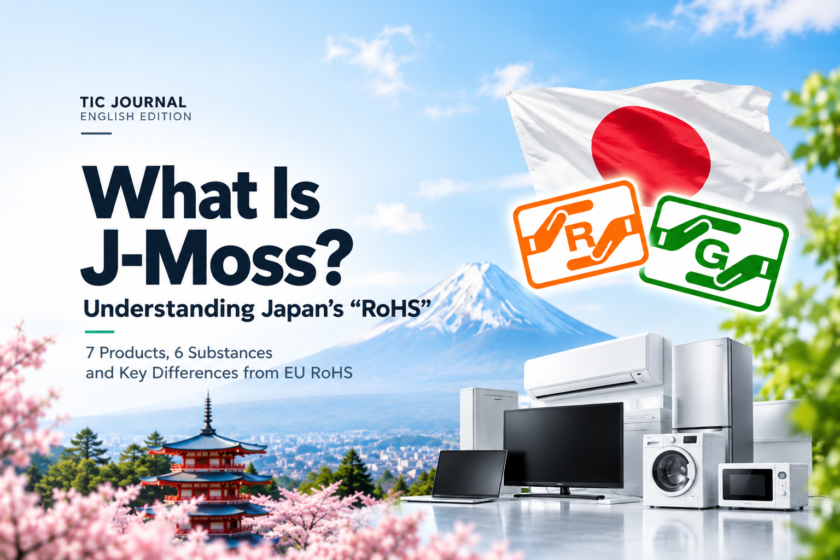
When companies encounter Japan’s J-Moss requirements for the first time, they often assume that the system is simply the Japanese equivalent of the EU RoHS Directive.
The comparison is understandable. J-Moss addresses the same six substances covered by the original EU RoHS framework, including lead, mercury, cadmium, hexavalent chromium, PBB and PBDE.
However, the regulatory mechanisms are fundamentally different.
EU RoHS is primarily a substance restriction regime. J-Moss, by contrast, is primarily a marking and information disclosure framework for the presence of specified chemical substances.
Understanding this distinction is essential for manufacturers and importers placing electrical and electronic products on the Japanese market.
1. Is J-Moss Really “Japanese RoHS”?
J-Moss is frequently described internationally as “Japanese RoHS.” Even JEITA uses the expression “J-Moss (Japanese RoHS)” in its English-language information.
But this shorthand can be misleading if it is interpreted too literally.
J-Moss is not simply Japan’s version of EU RoHS.
The fundamental difference can be summarized as follows:
Restricts the use of specified hazardous substances in electrical and electronic equipment, subject to applicable exemptions.
Focuses on marking and communicating the presence of specified chemical substances under defined conditions.
This distinction affects how companies determine compliance, what happens when a threshold is exceeded, and what information must be provided to the Japanese market.
J-Moss should therefore be understood as its own regulatory framework rather than simply as Japan’s version of EU RoHS.
2. What Is J-Moss?
J-Moss is the commonly used name for JIS C 0950, the Japanese Industrial Standard titled:
“The marking for presence of the specific chemical substances for electrical and electronic equipment”
The name “J-Moss” combines the “J” for Japan with letters derived from the English title of the standard.
The current standard is JIS C 0950:2021.
Importantly, J-Moss is not merely a voluntary environmental labeling initiative.
JIS C 0950 is referenced under Japan’s Law for Promotion of Effective Utilization of Resources, creating marking and information disclosure requirements for designated products under specified conditions.
3. Why Does Japan Have J-Moss?
The background of J-Moss is closely connected with Japan’s resource-efficiency and recycling policy.
Electrical and electronic equipment contains many different materials and chemical substances. When products reach the end of their useful life, information about these substances can be important for recycling and treatment operations.
J-Moss therefore serves not only product users but also the downstream recycling system.
J-Moss is designed with the product’s post-market lifecycle in mind, including collection, recycling and appropriate treatment.
The system is intended to make information about specified chemical substances accessible for products covered by Japan’s resource-efficiency framework.
This is another reason why J-Moss should not be viewed only through the lens of chemical substance restriction.
4. Which Products Are Covered?
Unlike EU RoHS, J-Moss does not apply broadly to all categories of electrical and electronic equipment.
The mandatory framework covers the following seven designated product categories:
Manufacturers and importers placing products in these categories on the Japanese market need to determine whether the applicable J-Moss marking and information disclosure requirements are triggered.
A product should not be considered subject to J-Moss simply because it is electrical or electronic equipment. The first question is whether it falls within one of the seven designated categories.
5. Which Six Substances Are Covered?
J-Moss addresses six specified chemical substances.
| Substance | Symbol | Threshold |
|---|---|---|
| Lead | Pb | 0.1 wt% |
| Mercury | Hg | 0.1 wt% |
| Cadmium | Cd | 0.01 wt% |
| Hexavalent chromium | Cr(VI) | 0.1 wt% |
| Polybrominated biphenyls | PBB | 0.1 wt% |
| Polybrominated diphenyl ethers | PBDE | 0.1 wt% |
These are the same six substances originally covered by EU RoHS. However, similar substance lists and threshold values do not make the two regulatory systems equivalent.
Note: J-Moss assessment is not based simply on the concentration of a substance in the complete product. The applicable calculation unit, definitions and exemptions specified in JIS C 0950 must also be considered.
6. Does Exceeding the Threshold Mean the Product Cannot Be Sold?
No. This is one of the most important differences between J-Moss and EU RoHS.
Under J-Moss, exceeding a threshold does not automatically mean that the product is prohibited from sale.
Under EU RoHS, a restricted substance exceeding the applicable maximum concentration value generally means that the product does not comply, unless an applicable exemption applies.
J-Moss works differently. When a specified substance exceeds the applicable value, the framework may require the manufacturer or importer to mark the presence of the substance and disclose information about its presence.
The company must therefore determine whether an exemption applies and whether marking and information disclosure requirements are triggered.
Other Japanese laws may separately restrict a substance. The fact that J-Moss itself is primarily a marking and disclosure framework does not override requirements under other applicable chemical regulations.
7. The Orange Content Mark and the J-Moss Green Mark
J-Moss uses two visually distinctive concepts that are often confused: the orange content mark and the voluntary J-Moss Green Mark.
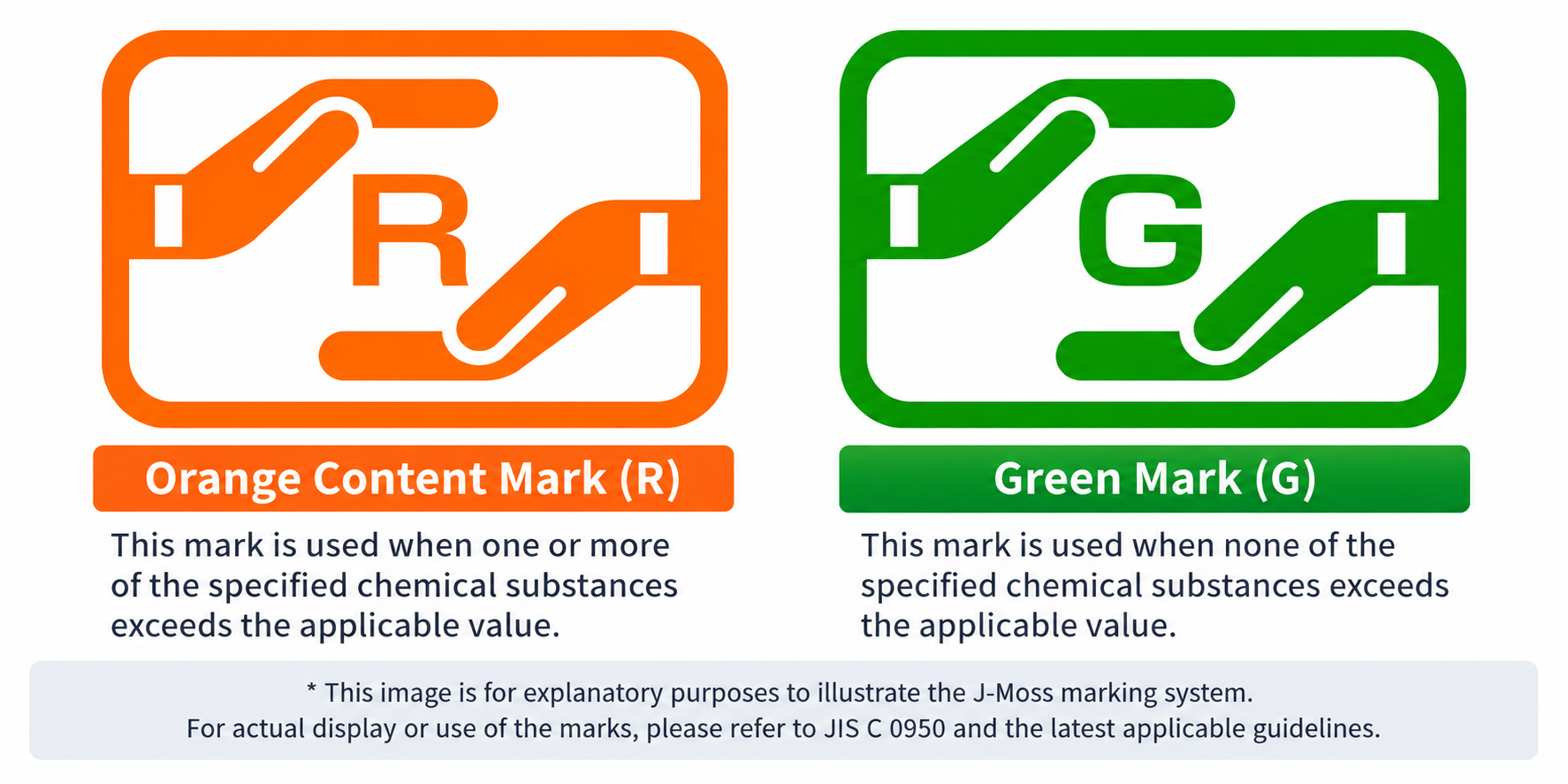
The Orange Content Mark
Where one or more of the six specified substances exceeds the applicable value and does not fall within an applicable exemption, the orange content mark is required.
The requirement does not end with displaying the mark. Information on the presence of the relevant substances must also be provided in accordance with the applicable J-Moss requirements.
The orange content mark does not mean that the product is “dangerous.”
Its purpose is to communicate the presence of specified chemical substances above the applicable values under the J-Moss framework.
The J-Moss Green Mark
Where the orange content mark is not required, the J-Moss Green Mark may be used voluntarily when the applicable conditions under the relevant industry guideline are satisfied.
The Green Mark should not be interpreted as evidence that a product has obtained a third-party “J-Moss certification.”
The Green Mark is a voluntary mark, not a third-party product certification.
The orange content mark and the Green Mark therefore differ not only in what they communicate, but also in their regulatory status: one may be required under specified conditions, while the other is voluntary.
8. Is J-Moss a Certification Scheme?
No. J-Moss is not a product certification scheme under which companies submit an application to a third-party certification body and receive a J-Moss certificate after approval.
Instead, manufacturers and importers assess their products and determine the appropriate marking and information disclosure requirements under JIS C 0950 and the applicable Japanese regulatory framework.
In practice, this means that the key question is not whether a company holds a “J-Moss certificate,” but whether it has sufficient evidence to support its assessment and marking decision.
Supporting evidence may include supplier declarations, material specifications, product chemical information, historical test data and laboratory analysis.
Key point: J-Moss compliance is fundamentally about maintaining reliable product and material information and being able to explain the basis for the applicable marking and disclosure decision.
Green Mark Procedures Are a Separate Matter
Procedures exist for the use and handling of the voluntary J-Moss Green Mark under the relevant industry guideline.
These procedures should not be confused with third-party certification of a product as “J-Moss compliant.” The voluntary use of the Green Mark and the regulatory assessment required under J-Moss are separate concepts.
9. Does Exceeding a Threshold Always Require the Orange Mark?
Not necessarily.
Exemptions are an important part of the J-Moss framework. JIS C 0950 provides exemptions for specified applications of certain chemical substances.
This means that a laboratory result showing a concentration above the applicable value does not, by itself, determine whether the orange content mark is required.
Companies need to identify where the substance is present, how the material or component is used, and whether an applicable exemption covers that use.
Three Practical Scenarios
The orange content mark and the required information disclosure apply.
The orange content mark may not be required, but information disclosure regarding the presence of the substance may still be necessary. The Green Mark may be used voluntarily where the applicable conditions are satisfied.
The orange content mark is not required. The Green Mark may be used voluntarily where the relevant conditions are met.
This is why J-Moss assessment requires more than simply comparing analytical results with numerical thresholds. Product construction, material use, exemptions, marking and disclosure all need to be considered together.
10. What Changed in JIS C 0950:2021?
Companies working with J-Moss should also be aware of the changes introduced by the 2021 revision of JIS C 0950.
The revision updated aspects of the marking system and reflected developments in Japan’s broader chemical regulatory framework.
1. JIS Revision Year Added to the Content Mark
Under JIS C 0950:2021, the applicable revision year of the JIS standard is incorporated into the content mark using a four-digit year.
This makes it possible to identify which edition of JIS C 0950 was used as the basis for the marking.
2. Revision of the DecaBDE Exemption
Another important change concerns decabromodiphenyl ether (DecaBDE), a substance within the PBDE group.
An exemption previously provided for DecaBDE in certain polymer applications was removed from Annex B in the 2021 revision.
The change reflected developments in Japan’s domestic chemical regulation, including restrictions on DecaBDE under the Chemical Substances Control Law.
Companies still relying on older J-Moss documentation or internal specifications should confirm that their requirements are aligned with JIS C 0950:2021.
J-Moss may be a long-established framework, but companies still need to monitor revisions to the standard and its relationship with other Japanese chemical regulations.
11. Is Chemical Testing Mandatory?
J-Moss does not mean that every component and material must automatically undergo laboratory testing.
The objective is not to test everything, but to establish reliable evidence on the presence of the six specified substances.
Depending on the product and supply chain, companies may use a combination of supplier information, material specifications, declarations, existing analytical data and chemical testing.
Chemical substance information for components and materials
Material specifications and compliance documentation
Historical analytical data for relevant materials
Additional verification where information is insufficient
Testing becomes particularly useful where supplier information is unavailable, incomplete, outdated or otherwise insufficient to support the assessment.
The practical question is therefore not simply:
“Have we tested all six substances?”
A more useful question is:
“Do we have sufficient evidence to support our J-Moss assessment?”
In this sense, J-Moss compliance is part of a broader product chemical management process rather than simply a six-substance testing exercise.
12. What Testing May Be Used?
Where laboratory analysis is required, different methods may be used depending on the substance, material and purpose of the assessment.
| Target | Example Method | Purpose |
|---|---|---|
| Pb / Hg / Cd / Cr | XRF screening | Rapid screening for relevant elements |
| Pb / Hg / Cd | ICP-based analysis and other suitable quantitative methods | Quantitative determination of metal content |
| Hexavalent chromium | Cr(VI)-specific analysis | Determine the relevant chromium oxidation state |
| PBB / PBDE | GC-MS or other suitable analytical techniques | Identify and quantify brominated flame retardants |
XRF can be highly useful as a screening technique, but detecting total chromium or bromine does not by itself demonstrate the presence of hexavalent chromium, PBB or PBDE. Further analysis may be required.
The appropriate analytical approach should be selected according to the material, available supplier information, screening results and compliance risk.
13. J-Moss vs. EU RoHS
The similarities in substance lists can make J-Moss and EU RoHS appear closely aligned. Their regulatory mechanisms, however, are fundamentally different.
| Item | J-Moss | EU RoHS |
|---|---|---|
| Jurisdiction | Japan | European Union |
| Regulatory basis | Law for Promotion of Effective Utilization of Resources + JIS C 0950 | RoHS Directive |
| Core mechanism | Marking and information disclosure | Restriction of specified hazardous substances |
| Product scope | Seven designated product categories | Broad range of electrical and electronic equipment |
| Substances | 6 | 10 |
| Above applicable value | Marking and disclosure depending on the applicable conditions | Generally restricted unless an applicable exemption applies |
| System-specific marking | Orange content mark; voluntary Green Mark | No RoHS-specific conformity mark |
| Dedicated product certification | No | No |
The two systems share an interest in managing hazardous substances in electrical and electronic equipment, but they do not impose the same regulatory obligations.
EU RoHS compliance therefore does not automatically mean that all J-Moss obligations have been fulfilled.
14. What Should Overseas Manufacturers Exporting to Japan Consider?
J-Moss is a Japanese regulatory framework, but it is highly relevant to overseas manufacturers whose products are placed on the Japanese market.
For products within the seven designated categories, the parties responsible for placing those products on the Japanese market need to ensure that the applicable marking and information disclosure requirements can be met.
A common challenge is that an overseas manufacturer may already maintain extensive EU RoHS documentation but may not have organized the information needed for a J-Moss-specific determination.
• Is the product within one of the seven designated categories?
• Is the presence of the six specified substances understood?
• Are any applicable values exceeded?
• Do any exemptions apply?
• Is the orange content mark required?
• Can the required information be provided appropriately for the Japanese market?
This makes access to reliable supply-chain information particularly important. Japanese importers may need supporting information from overseas manufacturers and component suppliers in order to make the appropriate J-Moss determination.
For global supply chains, J-Moss is therefore not merely a labeling issue. It is also a product chemical-information management issue.
15. Why the Term “Japanese RoHS” Can Be Misleading
Calling J-Moss “Japanese RoHS” is convenient and can be useful as a first introduction to the system.
In practice, however, the shorthand can obscure several important differences.
The mandatory J-Moss framework applies to seven designated product categories.
EU RoHS focuses on substance restriction, while J-Moss focuses on marking and information disclosure.
Under J-Moss, exceeding an applicable value does not by itself create an automatic sales prohibition.
Depending on the circumstances, marking and disclosure of chemical-content information become central obligations.
At the same time, companies that already maintain robust EU RoHS documentation have an important advantage. Supplier declarations, material data and analytical results developed for RoHS can provide valuable evidence for J-Moss assessments.
The key is not to simply relabel an EU RoHS assessment as “J-Moss compliant,” but to evaluate the product against the Japanese framework, including its product scope, substances, exemptions, marking and disclosure requirements.
J-Moss Compliance Is About More Than Testing Six Substances
It is tempting to approach J-Moss as a laboratory-testing exercise: test six substances, compare the results with the applicable values, and determine compliance.
In practice, the more important challenge is maintaining reliable product and material information and being able to explain why a particular marking and disclosure decision is appropriate.
Some materials may be supported by comprehensive supplier documentation. Others may require additional verification because information is incomplete, outdated or affected by a material change.
Testing is therefore an important part of the compliance toolbox, but it is only one part.
From a TIC perspective, effective J-Moss management combines product chemical information, supplier evidence, risk-based testing, and appropriate marking and disclosure.
The central question is not only:
“What should be tested?”
It is also:
“What evidence supports our J-Moss decision, and how will that evidence remain reliable throughout the product lifecycle?”
Related Articles
About This Article
This article provides an overview of J-Moss and JIS C 0950 based on publicly available information as of 2026, with a focus on the regulatory framework and practical considerations for companies.
This article is intended for general informational purposes only and does not constitute a determination of regulatory compliance for any specific product. Companies should refer to the latest applicable laws, JIS C 0950 and relevant official guidance when making compliance decisions.
Primary References
・Ministry of Economy, Trade and Industry (METI), Japan — Law for Promotion of Effective Utilization of Resources
・Ministry of Economy, Trade and Industry (METI), Japan — Information on J-Moss and the marking of specified chemical substances in electrical and electronic equipment
・Japanese Industrial Standards Committee / Japanese Standards Association — JIS C 0950:2021, The marking for presence of the specific chemical substances for electrical and electronic equipment
・Japan Electronics and Information Technology Industries Association (JEITA) — J-Moss guidance



コメント