



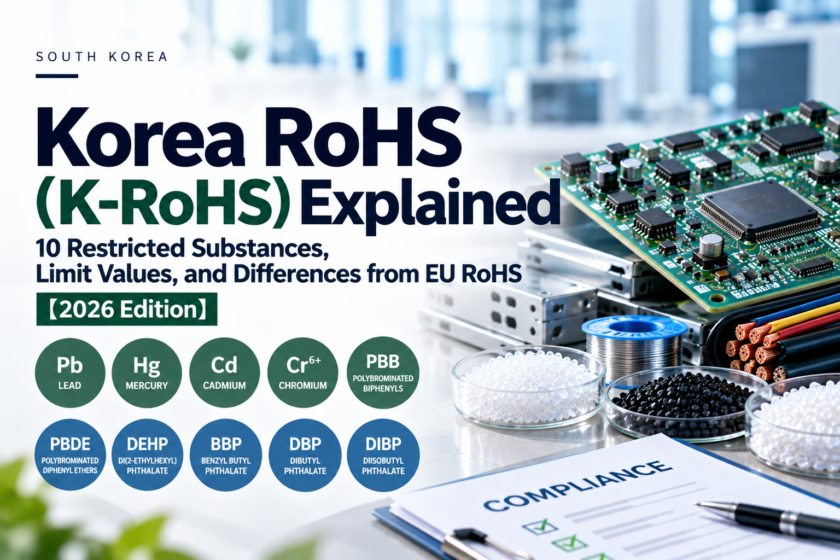
When exporting electrical and electronic equipment to South Korea, manufacturers often ask a simple question: Does South Korea have its own RoHS regulations?
The answer is yes. A regulatory framework commonly referred to as Korea RoHS or K-RoHS exists, although South Korea does not have a standalone law officially titled “RoHS.”
The main legislation is the Act on Resource Circulation of Electrical and Electronic Equipment and Vehicles.
This legislation restricts certain hazardous substances in electrical and electronic equipment and vehicles, including lead, mercury, cadmium, hexavalent chromium, flame retardants and phthalates.
However, the Korean framework extends beyond hazardous substance restrictions. It also addresses product design, recycling and resource circulation.
This guide explains the 10 restricted substances, concentration limits, covered products, exemptions, differences from EU RoHS, and practical compliance considerations for companies exporting to South Korea.
1. What Is Korea RoHS (K-RoHS)?
Korea RoHS is the commonly used name for the hazardous substance restrictions established under South Korea’s Act on Resource Circulation of Electrical and Electronic Equipment and Vehicles.
The legislation aims to reduce the use of hazardous substances, promote product designs that facilitate recycling, and ensure the appropriate recycling of waste electrical and electronic equipment and vehicles.
Unlike a regulation focused exclusively on chemical substance restrictions, the Korean framework combines several elements of resource circulation policy.
+
Design for Recycling
+
Collection and Recycling of End-of-Life Products
This broader structure is one of the important differences between Korea RoHS and the EU RoHS Directive.
2. How Does Korea RoHS Differ from EU RoHS?
Korea RoHS and EU RoHS share many similarities, particularly regarding restricted substances and concentration limits for electrical and electronic equipment.
However, their legal structures and product coverage are not identical.
| Item | EU RoHS | Korea RoHS |
|---|---|---|
| Legal Framework | RoHS Directive | Act on Resource Circulation of Electrical and Electronic Equipment and Vehicles |
| Primary Focus | Restriction of hazardous substances in electrical and electronic equipment | Hazardous substance restrictions and resource circulation |
| Electrical and Electronic Equipment | Covered | Covered |
| Vehicles | Generally outside the scope of RoHS | Included in the Korean legislation |
| Restricted Substances | 10 substances | 10 substances for electrical and electronic equipment |
| Concentration Basis | Homogeneous material | Material defined under Korean regulations |
| Recycling Requirements | Addressed through separate legislation, including WEEE | Integrated into the broader resource circulation framework |
EU RoHS primarily restricts hazardous substances in electrical and electronic equipment.
Korea RoHS forms part of a broader legal framework covering hazardous substances, product design and recycling.
RoHS at 20: How Hazardous Substance Restrictions Transformed Global Manufacturing
3. The 10 Restricted Substances under Korea RoHS
For covered electrical and electronic equipment, Korea RoHS restricts 10 hazardous substances.
| Restricted Substance | Maximum Concentration |
|---|---|
| Lead (Pb) | 0.1% |
| Mercury (Hg) | 0.1% |
| Hexavalent Chromium (Cr6+) | 0.1% |
| Polybrominated Biphenyls (PBB) | 0.1% |
| Polybrominated Diphenyl Ethers (PBDE) | 0.1% |
| Bis(2-ethylhexyl) Phthalate (DEHP) | 0.1% |
| Butyl Benzyl Phthalate (BBP) | 0.1% |
| Dibutyl Phthalate (DBP) | 0.1% |
| Diisobutyl Phthalate (DIBP) | 0.1% |
| Cadmium (Cd) | 0.01% |
The four phthalates—DEHP, BBP, DBP and DIBP—were added to the Korean restrictions in 2021.
The resulting list of 10 restricted substances closely corresponds to the substances regulated under EU RoHS.
Nine substances: 0.1% (1,000 mg/kg)
Cadmium: 0.01% (100 mg/kg)
4. Concentration Limits Do Not Apply to the Entire Product
One of the most important practical considerations is how the concentration limits are applied.
The limits are not calculated simply against the total weight of a finished product.
Korean regulations use a material-based concept similar to the homogeneous material principle under EU RoHS.
This generally concerns materials that cannot be separated into different materials through mechanical processes.
Examples include plastics, metals, alloys, glass, ceramics, coatings and other individual material layers.
A finished product containing less than 0.1% of a restricted substance by total weight is not necessarily compliant.
Compliance must be evaluated using the applicable material-based concentration requirements.
5. Which Products Are Covered by Korea RoHS?
Not all electrical and electronic products are automatically subject to the hazardous substance restrictions.
The Korean legislation defines electrical and electronic equipment broadly, including machinery and devices that generate, transfer, transmit or measure electric currents or electromagnetic fields, or operate using them.
However, the specific products subject to hazardous substance restrictions are determined by the relevant Enforcement Decree.
Companies exporting to South Korea should therefore confirm whether their products fall within the applicable product categories.
A product should not be assumed to fall within Korea RoHS simply because it operates using electricity.
The applicable product category must be confirmed under Korean legislation.
6. Products Excluded from the Scope
The Korean framework provides exclusions for certain electrical and electronic products.
Examples include:
- Electrical and electronic equipment used as vehicle components
- Certain military and national security equipment
- Large-scale stationary industrial tools
- Large-scale fixed installations
- Certain medical devices
The precise scope of each exclusion depends on the relevant Korean legal provisions and conditions.
Importantly, an exclusion under EU RoHS does not automatically establish an equivalent exclusion under Korea RoHS.
Each regulatory framework must be assessed independently.
7. Vehicles Are Subject to Different Substance Restrictions
Another distinctive feature of the Korean legislation is its coverage of certain vehicles.
However, the substance restrictions for vehicles are different from those applicable to electrical and electronic equipment.
For covered vehicles, four hazardous substances are restricted.
| Restricted Substance | Maximum Concentration |
|---|---|
| Lead | 0.1% |
| Mercury | 0.1% |
| Hexavalent Chromium | 0.1% |
| Cadmium | 0.01% |
Vehicles: 4 Substances
The number of restricted substances depends on the applicable product category.
8. Are There Exemptions?
The presence of a restricted substance does not necessarily mean that a product is non-compliant.
Korean legislation provides exemptions for certain applications where the removal or substitution of hazardous substances is technically impracticable or where specific legal conditions are satisfied.
Research and development activities and products intended for export are also addressed through specific provisions.
Applicable exemptions must be confirmed against the current Enforcement Decree and its relevant annexes.
↓
Does the material exceed a restricted substance limit?
↓
Does an applicable exemption exist?
A substance concentration exceeding the general limit should therefore be assessed together with the applicable exemptions before reaching a final compliance conclusion.
9. How Can Companies Verify Korea RoHS Compliance?
For manufacturers, the practical challenge is determining what information and testing are needed to establish compliance.
A structured approach can help avoid unnecessary testing while identifying gaps in existing documentation.
↓
Collect Supplier Information
↓
Review Restricted Substance Data
↓
Identify Missing Information
↓
Conduct Testing Where Necessary
↓
Check Applicable Exemptions
Testing every component from the beginning is not necessarily required.
Companies can first review existing material declarations, supplier documentation and test reports.
Additional testing can then be considered for materials with insufficient information or a higher risk of containing restricted substances.
Material-Level Testing Is Important
Because concentration limits are applied at the material level, testing should consider the individual materials used in a product.
Examples include:
- Plastic components
- Metal parts
- Solder
- Coatings
- Cable insulation
- Adhesives
- Other individual materials
Phthalates are particularly relevant to certain plastics and cable materials, making material identification an important part of compliance planning.
10. Can EU RoHS Test Reports Be Used for Korea RoHS?
This is an important practical question for companies supplying products to multiple markets.
Because the 10 restricted substances and concentration limits for electrical and electronic equipment are closely aligned, existing EU RoHS documentation may provide a useful foundation for Korea RoHS compliance assessment.
Relevant documentation may include:
- Material composition information
- Chemical substance declarations
- RoHS test reports
- Supplier compliance declarations
However, EU RoHS compliance does not automatically establish Korea RoHS compliance.
Product coverage, exemptions, applicable materials and Korean regulatory requirements must still be reviewed.
Use existing EU RoHS data where appropriate, then identify and address differences under Korean regulations.
11. What Should Companies Check Before Exporting to South Korea?
For manufacturers and exporters, the following sequence provides a practical starting point.
STEP 1 — Identify the Product
Confirm the product name, intended use, electrical or electronic functions, and how the product will be supplied in South Korea.
STEP 2 — Confirm Product Coverage
Determine whether the product falls within the categories subject to hazardous substance restrictions under Korean legislation.
STEP 3 — Identify Restricted Substances
Confirm the applicable substances and concentration limits according to the product category.
STEP 4 — Review Material and Component Information
Collect existing material declarations, supplier information and relevant test reports.
STEP 5 — Identify Data Gaps
Determine which materials lack sufficient documentation or may present a higher compliance risk.
STEP 6 — Conduct Additional Testing Where Necessary
Consider targeted testing for materials requiring further confirmation.
STEP 7 — Confirm Applicable Exemptions
Where restricted substances exceed the general concentration limits, review whether a relevant exemption applies.
The most important point in understanding Korea RoHS is that it should not be treated simply as a Korean copy of EU RoHS.
The two frameworks share the same 10 restricted substances and closely aligned concentration limits for electrical and electronic equipment.
This means that manufacturers may be able to use material information and testing data already collected for EU RoHS compliance.
However, Korea RoHS forms part of a broader resource circulation framework covering electrical and electronic equipment and vehicles.
Product coverage, exclusions, exemptions and vehicle-related requirements must therefore be considered separately.
↓
Confirm Korea RoHS Coverage
↓
Review Restricted Substances and Limits
↓
Evaluate Existing EU RoHS Documentation
↓
Address Remaining Data Gaps and Testing Needs
For companies exporting to multiple markets, the most efficient approach is not necessarily to repeat testing for each country.
Instead, existing material information and test reports can be organized and evaluated against the specific requirements of each regulatory framework.
TICnology Japan supports companies in reviewing product structures, target markets and existing RoHS documentation, and in evaluating suitable compliance approaches and service providers for Korea RoHS and other international regulations, including additional testing or regulatory assessment where necessary.
For electrical and electronic products exported to South Korea, TICnology Japan can help organize product information, target markets and existing RoHS documentation, and support the evaluation of suitable compliance approaches and service providers, including necessary testing and regulatory assessment.
Korean National Law Information Center, Act on Resource Circulation of Electrical and Electronic Equipment and Vehicles
Korean National Law Information Center, Enforcement Decree of the Act on Resource Circulation of Electrical and Electronic Equipment and Vehicles
Korean National Law Information Center, Enforcement Rule of the Act on Resource Circulation of Electrical and Electronic Equipment and Vehicles
Enforcement Decree, Attached Table 1-2: Hazardous Substance Concentration Limits
Enforcement Decree, Attached Table 2: Exemptions from Hazardous Substance Concentration Limits
Information reviewed as of October 9, 2026.
This article provides general information on Korea RoHS and related legislation and does not constitute legal advice for individual cases. Companies should confirm the latest laws, enforcement decrees, enforcement rules, official notices and applicable product requirements before making compliance decisions.
コメント