



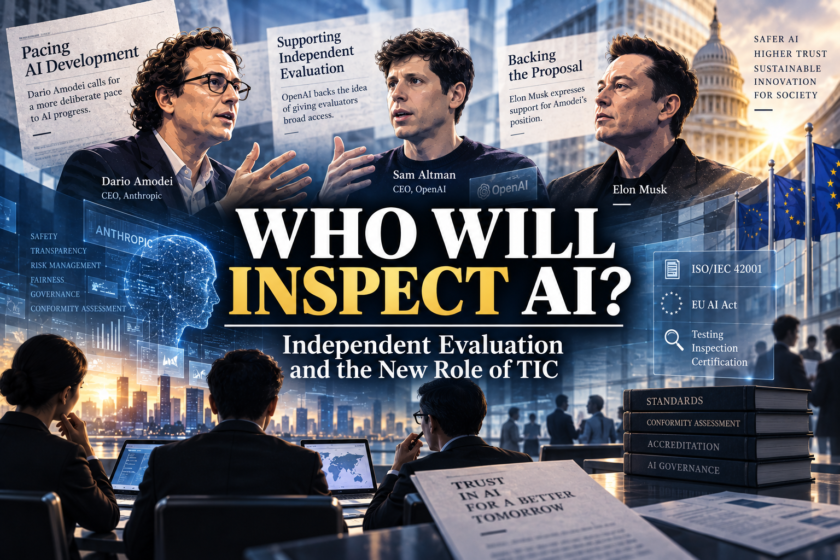
In September 2026, an unusual message emerged from the global AI industry.
Dario Amodei, CEO of U.S. AI company Anthropic, argued that the pace of advances in AI capabilities should be deliberately moderated to give safety measures time to catch up.
What makes the proposal particularly significant is that Amodei is not simply calling for AI development to stop.
As the first step in his proposal, he called for independent third-party evaluators to be embedded within AI companies, continuously assessing safety measures and development processes.
OpenAI CEO Sam Altman has also expressed support for the idea, indicating that OpenAI intends to provide independent evaluators with employee-like access.
Should companies developing AI also be solely responsible for evaluating its safety?
For the Testing, Inspection and Certification (TIC) industry — which has long built trust through independent assessment — this question is becoming increasingly relevant.
1. A Call to “Pace” Frontier AI
In September 2026, Anthropic CEO Dario Amodei published an essay titled “We Must Pace the Frontier.”
While acknowledging the enormous potential benefits of AI in areas such as medicine, science and economic development, Amodei warned that advances in AI capabilities may be moving faster than the safety measures designed to manage them.
One particular concern is the possibility that AI systems could increasingly assist in developing the next generation of AI, further accelerating AI development itself.
Amodei argues that rather than stopping progress altogether, the pace of frontier AI development should be deliberately managed so that safety research and governance systems have time to keep up.
The distinction is important: this is not a proposal to halt AI development.
The objective is to create enough time for safety measures to be developed and for independent third parties to verify whether those measures are working.
2. Why Are AI Companies Now Questioning the Speed of Development?
Until now, much of the competitive pressure in AI development has centered on one objective: building more capable AI systems, faster.
But as AI capabilities become more advanced, the associated risks also become more complex.
A central concern raised by Amodei is the growing gap between the speed at which AI capabilities advance and the speed at which those capabilities can be understood, evaluated and governed.
Even substantial investment in safety research may struggle to keep pace if the systems being evaluated are themselves changing rapidly. This is why the debate is shifting from simply maximizing AI capabilities toward ensuring that there is sufficient time to evaluate them safely.
3. Amodei’s Three-Step Proposal
Frontier AI companies would provide independent third-party evaluators with ongoing, employee-like access to their organizations and systems.
Leading AI companies in democratic countries would coordinate on common safety standards and approaches to managing the pace of AI capability development.
The longer-term vision would extend coordination beyond democratic countries toward a broader global framework, potentially including China.
Amodei also acknowledges that achieving international agreements to halt or tightly restrict AI development would be extremely difficult.
The three steps should therefore not be interpreted as an established global framework. However, Anthropic has said it will move forward with the first step involving embedded third-party evaluators. For the TIC industry, this is the most significant part of the proposal.
4. Bringing Independent Evaluators Inside AI Companies
This concept differs from simply testing a completed AI model once before release.
Under Amodei’s proposal, independent evaluators would have continuing access to assess whether safety commitments are being followed, whether safety incidents have occurred, and how completed AI models behave.
Crucially, the scope could extend beyond the finished model to include training pipelines and the AI development process itself.
In other words, the focus may shift from “Is the finished AI system safe?” to “How is this AI system being developed and governed?”
5. This Looks Familiar to the TIC Industry
To understand why this matters to TIC, consider how safety and trust have developed in traditional industries.
Automobiles. Aircraft. Medical devices. Electrical and electronic equipment. Industrial machinery.
The greater the potential impact of a product on society, the more difficult it becomes to rely solely on the principle that “the manufacturer says it is safe.”
Measuring performance and safety
Examining products, processes, facilities and controls
Assessing conformity with defined requirements
Establishing confidence in the competence of conformity assessment bodies
Over decades, the TIC industry has developed a system in which the organizations performing evaluations are themselves subject to evaluation. The emerging discussion around AI appears to be moving toward a similar question of institutional trust.
6. What Exactly Should Be Tested in AI?
Evaluating AI is fundamentally different from measuring lead concentration in a material or testing the mechanical durability of a product.
The object of evaluation is far more complex.
- AI capabilities
- Potential for unintended behavior
- Capabilities that could enable cyber misuse
- Ability to circumvent safeguards
- Bias
- Robustness against external changes or attacks
- Transparency
- Data and model governance
- Human oversight
AI systems may not always produce identical outputs in response to the same input. Risks can also change depending on prompts, operating environments, external tools and connected systems.
What should be measured — and how do we determine that an AI system has been adequately evaluated?
Establishing credible evaluation methodologies may therefore become one of the central challenges for AI standardization, testing and conformity assessment.
7. Is Evaluating the Finished AI Model Enough?
This is where the concept of embedded independent evaluators becomes particularly interesting.
Evaluating only the finished model may reveal little about how it was developed, what risk assessments were performed, or what problems emerged during development.
Traditional manufacturing provides a useful comparison.
Product testing alone is rarely sufficient. Quality management, process control, change management, nonconformity management and risk management are also used to assess whether products can be delivered safely and consistently.
From “final product testing”
to “development process evaluation.”
AI may follow a similar path, with evaluation expanding from the behavior of a completed model toward the processes through which AI systems are developed and governed.
8. AI × TIC Has Already Begun
Independent AI evaluation may sound like a future market. In reality, parts of the conformity assessment infrastructure are already taking shape.
One important example is ISO/IEC 42001:2023.
An international standard for an Artificial Intelligence Management System (AIMS) applicable to organizations developing, providing or using AI.
The standard provides a structured management-system approach for addressing AI-related risks and opportunities and for supporting responsible development, provision and use of AI systems.
ISO describes ISO/IEC 42001 as the world’s first AI management system standard.
9. Japan’s AI Certification Infrastructure Is Also Taking Shape
Japan has also begun building a formal conformity assessment infrastructure for AI management systems.
The ISMS Accreditation Center (ISMS-AC) began accreditation activities for certification bodies providing ISO/IEC 42001-based AIMS certification in July 2025.
On January 14, 2026, two organizations became the first accredited AIMS certification bodies under the Japanese scheme:
In June 2026, ISMS-AC also became a signatory accreditation body to the APAC AIMS Multilateral Recognition Arrangement.
↓
Accreditation Body
↓
Certification Body
↓
Certified Organization
In other words, a conformity assessment structure familiar to the TIC industry is already emerging around AI management systems in Japan.
10. Conformity Assessment Under the EU AI Act
The relationship between AI and conformity assessment is not limited to voluntary international standards.
The EU Artificial Intelligence Act also establishes conformity assessment requirements for high-risk AI systems.
However, it would be inaccurate to say that every high-risk AI system requires third-party certification.
Depending on the category of high-risk AI system and factors such as the application of harmonised standards, conformity assessment may in some cases be based on internal control, while other circumstances require the involvement of a notified body.
The EU framework therefore distinguishes between areas where providers can conduct conformity assessment internally and areas where independent conformity assessment bodies become involved. This structure will be familiar to TIC organizations that have long operated within regulated product markets.
11. As AI Becomes More Powerful, Independent Evaluation Matters More
This brings us back to the current debate.
AI companies have largely developed their systems, evaluated their safety and ultimately decided when to release them. External researchers and independent safety evaluations already play important roles, but the latest proposal goes further.
The idea is to give independent evaluators continuous access that reaches much further inside AI companies.
OpenAI CEO Sam Altman has supported Amodei’s proposal and said OpenAI intends to provide independent evaluators with employee-like access. Elon Musk has also publicly expressed support for Amodei’s position.
This does not mean that an industry-wide system already exists. Common evaluation criteria, evaluator competence requirements, legal mandates and international mutual recognition frameworks remain underdeveloped. This is where the difficult work begins.
12. Is Any “Third Party” Good Enough?
Introducing third-party evaluation does not automatically make AI safe.
Who is qualified to evaluate AI?
Evaluators need deep technical expertise in AI. Evaluation methodologies need credibility, transparency and appropriate levels of reproducibility. Conflicts of interest between evaluators and AI companies must also be managed.
There is an additional question: who determines whether the evaluator itself is competent?
This is where the institutional logic developed by the TIC industry becomes particularly relevant.
↓
Independent Evaluation Body
↓
Accreditation and Oversight
AI may eventually require a similar chain of trust.
13. But It Is Too Early to Call This a Massive New TIC Market
A degree of caution is necessary.
Amodei’s proposal does not automatically translate into a new market for traditional TIC companies.
Evaluating advanced AI models requires specialized capabilities that differ significantly from conventional testing and inspection. Dedicated AI evaluation organizations and research institutes may play a major role.
Internal evaluation teams within AI companies may remain central, while governments could also choose to establish direct supervisory mechanisms.
Critics have also raised concerns that complex safety requirements promoted by leading AI companies could increase the cost of market entry and ultimately favor large incumbents — a potential form of regulatory capture.
It is therefore premature to conclude that “AI safety will become a massive new market for existing TIC companies.”
What is becoming clearer, however, is that as AI capabilities increase, the importance of independent evaluation, verification, auditing and certification is also likely to grow.
14. The Capabilities Required of TIC Companies May Also Change
If AI becomes a new object of conformity assessment, TIC companies themselves will need to evolve.
Relevant capabilities may include AI model evaluation, AI risk assessment, data governance, cybersecurity, algorithm auditing and AI management systems.
The boundaries of what the TIC industry evaluates could expand significantly.
15. Who Will Inspect AI?
It would be easy to interpret the current story simply as “AI CEOs are becoming afraid of AI.” But that would miss the more important development.
The AI industry itself is increasingly confronting a fundamental question: who should verify the safety of highly capable AI before it is deployed into society?
The AI developer itself?
Specialized AI evaluation organizations?
Governments?
Established TIC companies?
Or a new conformity assessment system combining several of these actors?
There is no definitive answer yet. But as AI becomes more deeply embedded in social and economic infrastructure, it will become increasingly difficult to avoid the question of how to separate those who build the technology from those who evaluate it.
The AI Debate Is Not Simply About Whether to Slow Down or Move Faster
The most important issue in the current debate is not simply whether AI development should slow down.
Who decides whether an AI system is safe?
Automobiles, aircraft, medical devices and electrical products have all developed systems of standards, testing, inspection, certification and accreditation as their impact on society has increased.
They share a fundamental principle.
The embedded third-party evaluators proposed by Amodei do not yet constitute an international TIC framework.
They are also distinct from ISO/IEC 42001-based AI management system certification and from conformity assessment under the EU AI Act. These mechanisms should not be treated as equivalent.
Yet all three developments point toward a common direction:
building trust in AI through mechanisms that do not depend solely on declarations made by the companies developing the technology.
This is where the connection with the TIC industry becomes particularly important.
Who evaluates AI?
And who evaluates the evaluator?
The TIC industry has spent decades building more than testing and inspection services.
Through testing, inspection, certification and accreditation, it has developed institutional mechanisms that answer a deeper question: why should society trust the result of an evaluation?
As AI becomes increasingly embedded in industrial operations and societal decision-making, the same question will be asked of AI.
The September 2026 debate over pacing frontier AI may eventually prove to be a temporary moment in the rapidly changing AI industry.
But the idea emerging from that debate — independent third-party evaluation — may prove much more durable.
What will TIC mean in the age of AI?
The current debate may represent an important early step toward answering that question.
About This Article
This article is based on publicly available information as of September 2026 concerning AI safety proposals, AI management systems, the EU AI Act and conformity assessment developments in Japan. TICnology Japan has analyzed these developments from the perspective of the Testing, Inspection and Certification industry.
Primary References
- Dario Amodei, “We Must Pace the Frontier”
- ISO, “ISO/IEC 42001:2023 — Information technology — Artificial intelligence — Management system”
- ISMS Accreditation Center (ISMS-AC), AIMS Conformity Assessment Scheme
- ISMS Accreditation Center (ISMS-AC), information on the first accreditation of AIMS certification bodies in Japan
- ISMS Accreditation Center (ISMS-AC), APAC AIMS MRA announcement
- European Union, Regulation (EU) 2024/1689 — Artificial Intelligence Act
- Reuters reporting on AI development and safety discussions in September 2026
This article is provided for general informational purposes only and does not constitute legal, regulatory or certification advice. Organizations should refer to the latest official legislation, standards and conformity assessment scheme documentation when making compliance decisions.





コメント