



JAPAN CHEMICAL REGULATION
Managing chemicals requires more than knowing whether a substance is hazardous.
Companies also need to understand who handles a chemical, how much is handled, how much is released into the air, water or other parts of the environment, how much leaves a facility as waste or through other transfer routes, and what information must be communicated to the next company handling that chemical.
To make these chemical flows visible across society, Japan enacted the Chemical Management Promotion Law in 1999.
Its formal English name is the Act on the Assessment of Releases of Specified Chemical Substances in the Environment and the Promotion of Management Improvement.
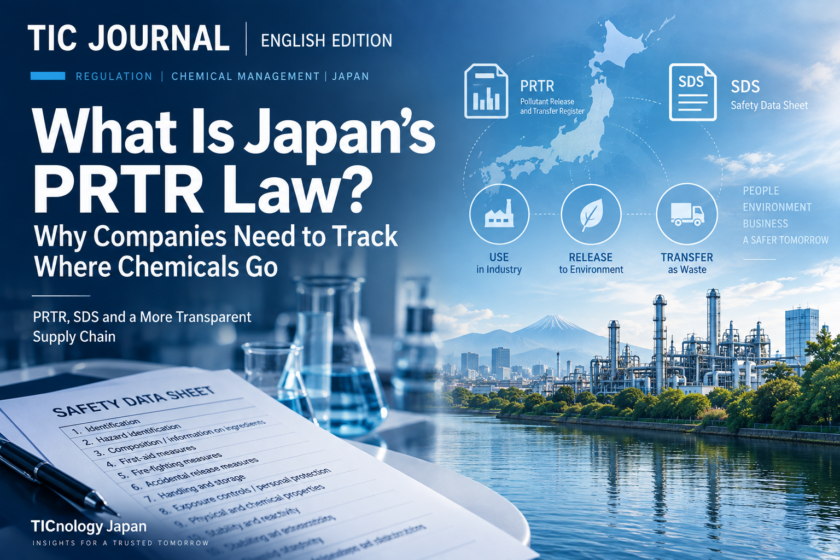
At the heart of the law are two systems: PRTR and SDS.
As of 2026, the law covers 515 Class I Designated Chemical Substances and 134 Class II Designated Chemical Substances. But with other Japanese chemical laws already in place, including the Chemical Substances Control Law and the Industrial Safety and Health Act, why is the PRTR Law necessary?
BASIC CONCEPT
1. What Is the PRTR Law? — It Is Not a Law That Simply “Bans” Chemicals
The name of the PRTR Law can sometimes create the impression that it is legislation designed to prohibit specific chemicals.
Its basic concept, however, is different.
The law is intended to promote improvements in the voluntary management of hazardous chemical substances by businesses and to prevent environmental problems before they occur.
Two major systems support this objective.
PILLAR 01
PRTR
Pollutant Release and Transfer Register
Businesses identify releases of designated chemical substances into the environment and transfers outside their facilities and, when specified requirements are met, report those quantities to the government.
PILLAR 02
SDS
Safety Data Sheet
When designated chemical substances, or products containing them above specified concentrations, are transferred or supplied between businesses, SDSs communicate information on their properties and safe handling.
TWO DIFFERENT ROLES
PRTR tracks where a chemical went.
SDS communicates what was supplied.
BACKGROUND
2. Why Was the PRTR System Needed?
Various laws governing chemical management existed long before the introduction of PRTR.
They addressed specific issues such as industrial wastewater, emissions to air, poisonous and deleterious substances, and worker safety.
However, there are practical limits to a system in which government authorities establish individual emission standards and directly control every one of the many chemical substances used throughout society.
“First, identify what is being released, where it is being released from, and in what quantity.”
This became an important principle.
Against the background of international initiatives including Agenda 21, adopted at the 1992 United Nations Conference on Environment and Development—the Earth Summit—the concept of identifying and publicly disclosing chemical releases spread internationally through PRTR systems.
Japan enacted the PRTR Law in 1999, creating a framework under which businesses themselves identify releases and transfers, while the government compiles and publishes the data so that chemical management can be improved across society.
PRTR
3. Understanding PRTR — The Difference Between “Releases” and “Transfers”
One of the most important concepts in understanding PRTR is the distinction between a release and a transfer.
Releases
Quantities of a chemical substance that leave a facility directly and enter the environment.
- Releases to air
- Releases to public water bodies
- Releases to soil within the facility
- On-site landfill disposal
Transfers
Quantities that do not enter the environment directly but leave the facility for treatment or other purposes.
- Transfers off-site as waste
- Transfers to sewerage systems
For example, suppose a company sends waste liquid containing a designated chemical substance to an external waste treatment company.
The chemical has not been discharged directly from the factory into a river. But it has not simply disappeared from the factory either.
PRTR distinguishes between chemicals that are released into the environment and chemicals that are transferred elsewhere.
This is why PRTR is a Pollutant Release and Transfer Register, rather than merely a reporting system for environmental emissions.
SUBSTANCES
4. Which Chemical Substances Are Covered by PRTR?
As of 2026, the core substances covered by Japan’s PRTR system are the 515 Class I Designated Chemical Substances.
| Category | Number | Main System |
|---|---|---|
| Class I Designated Chemical Substances | 515 | PRTR + SDS |
| Specific Class I Designated Chemical Substances | 23 | PRTR + SDS Stricter thresholds |
| Class II Designated Chemical Substances | 134 | SDS |
Class I Designated Chemical Substances are designated based on factors including hazards to human health or ecosystems and whether they are widely present in the environment or may become widely present in the future.
Among them, Specific Class I Designated Chemical Substances include substances recognized as presenting particularly significant hazards, including certain carcinogenic, mutagenic and reproductive toxic effects. Stricter reporting thresholds apply than for ordinary Class I substances.
REPORTING
5. Does Handling a Designated Substance Automatically Require PRTR Reporting?
No. Simply using even a small amount of a Class I Designated Chemical Substance does not automatically mean that a PRTR report must be filed.
MAIN CHECK POINTS
Covered business sector / Number of regular employees / Annual quantity handled at each facility / Facility requirements
As a general rule, reporting requirements apply in cases such as where the company operates in a covered business sector, has 21 or more regular employees across the business, and handles 1 tonne or more per year of a Class I Designated Chemical Substance at an individual facility.
For Specific Class I Designated Chemical Substances, the annual handling threshold is 0.5 tonnes or more. Certain facilities are also subject to requirements irrespective of the quantity handled.
KEY POINT
“Contains a PRTR substance” does not automatically mean “PRTR reporting is required.”
The appropriate sequence is:
Substance → Concentration in the Product → Business Sector → Company Size → Annual Quantity Handled → Facility Requirements
MATERIAL BALANCE
6. “Quantity Used” Is Not the Same as “Quantity Released”
Another common misunderstanding under PRTR concerns the relationship between the annual quantity handled and the quantity released.
For example, even if a facility uses 10 tonnes of a chemical substance in a year, this does not mean that all 10 tonnes are released into the environment.
How much entered the facility?
↓
How much went into products?
↓
How much was transformed through reactions or treatment?
↓
How much was released to air, water or other environmental media?
↓
How much was transferred as waste or through sewerage?
PRTR is not simply a system for reporting the amount of chemicals purchased.
It is also a framework for understanding the material balance of chemical substances.
TESTING & ANALYSIS
7. Does PRTR Reporting Require Everything to Be Measured?
The term PRTR may create the impression that every release must be determined through laboratory analysis.
That is not necessarily the case.
Release and transfer quantities can be calculated using various approaches, including mass balance calculations, actual measurement data, emission factors and physicochemical properties.
Analysis becomes important, however, where processes are complex, where concentrations in wastewater, exhaust gas or waste need to be determined, or where calculations alone cannot provide sufficient accuracy.
PRACTICAL PERSPECTIVE
In practical PRTR management, analysis is better understood not as a requirement to “measure everything”, but as a tool to “verify what needs to be confirmed.”
SDS
8. The Other Pillar — What Is an SDS?
The other major pillar of Japan’s PRTR Law is the SDS system.
SDS stands for Safety Data Sheet.
An SDS is a document used to systematically communicate information about a chemical product, including:
- Identification of the chemical product and company
- Hazard identification
- Composition and information on ingredients
- First-aid measures
- Fire-fighting and accidental release measures
- Handling and storage
- Exposure controls and personal protection
- Physical and chemical properties
- Stability and reactivity
- Toxicological and ecological information
- Disposal and transport considerations
- Regulatory information
An important point: SDS requirements are not unique to the PRTR Law.
SDS REGULATIONS
9. Why Do the PRTR Law, Industrial Safety and Health Act and Poisonous and Deleterious Substances Control Act All Require SDSs?
In chemical management practice in Japan, three major laws are closely associated with SDS requirements: the PRTR Law, the Industrial Safety and Health Act, and the Poisonous and Deleterious Substances Control Act.
These are often collectively referred to in Japan as the “three SDS laws.”
| Law | Main Purpose |
|---|---|
| PRTR Law | Management of environmental releases and promotion of voluntary improvements in chemical management |
| Industrial Safety and Health Act | Protection of worker safety and health |
| Poisonous and Deleterious Substances Control Act | Prevention of health and sanitation hazards caused by poisonous and deleterious substances |
In practice, a single SDS is commonly prepared to address requirements under multiple laws.
However, the substances covered and the scope of the obligations under these laws are not completely identical.
SDS SCOPE
10. Who Is Subject to SDS Requirements Under the PRTR Law?
PRTR reporting and SDS requirements differ in terms of which businesses are covered.
Under the SDS provisions of the PRTR Law, businesses that transfer or supply Class I or Class II Designated Chemical Substances, or covered products containing those substances at or above specified concentrations, to other businesses are subject to the relevant requirements.
CLASS I / CLASS II
1% by mass or more
SPECIFIC CLASS I
0.1% by mass or more
Unlike the PRTR reporting system, the SDS system does not restrict applicability by business sector.
DO NOT ASSUME
“Our company is not subject to PRTR reporting, so the PRTR Law does not apply to us.”
This is not necessarily correct.
EXEMPTIONS
11. Is an SDS Required for Every Product?
No. Under the PRTR Law, certain products may fall outside the scope of the SDS requirements.
- Products in which the concentration of a designated substance is below the applicable threshold
- Certain solid products that do not become non-solid, powdered or granular during handling
- Products used in a sealed state
- Certain products intended for general consumer use
- Certain recyclable resources
However, it is not appropriate to conclude simply that “a solid product is exempt.”
Products that may generate dust or other forms of exposure through processes such as cutting, grinding or melting may potentially fall within the scope of the requirements.
Whether an SDS is required therefore needs to be assessed not only from the substance name, but also from the concentration, product form, method of use or processing, and manner of distribution.
GHS & SDS
12. GHS and SDS Are Not the Same Thing
GHS stands for the Globally Harmonized System of Classification and Labelling of Chemicals.
It is an internationally harmonized framework for classifying chemical hazards and communicating that information through tools such as labels and SDSs.
GHS
An international framework for classifying and communicating hazard information
SDS
A document used to communicate that information
PRTR Law
A Japanese legal framework that, among other requirements, requires SDS provision for specified chemical substances
Treating these three concepts as if they were the same makes the overall regulatory framework more difficult to understand.
CSCL VS PRTR LAW
13. How Is the Chemical Substances Control Law Different From the PRTR Law?
Japan’s Chemical Substances Control Law and PRTR Law are sometimes confused because of their similar Japanese names. Their roles, however, are quite different.
| Chemical Substances Control Law | PRTR Law | |
|---|---|---|
| Main Perspective | Assessment, evaluation and regulation of chemical substances themselves | Releases, transfers and information communication |
| Representative Systems | New chemical substance review, risk assessment, etc. | PRTR and SDS |
| In Simple Terms | How a chemical substance is managed in Japan | Where it goes and what information is communicated |
The two laws are not competing systems.
They support chemical management in Japan from different perspectives.
REGULATORY UPDATE
14. The List of Designated Substances Was Significantly Revised in 2023
The substances covered by the PRTR Law are not fixed permanently.
They are reviewed in light of factors such as new knowledge concerning hazards, detection in the environment, release volumes, and manufacturing and import volumes.
CLASS I
462 → 515
CLASS II
100 → 134
The relevant Cabinet Order was amended in 2021 and entered into force on April 1, 2023. For PRTR reporting, the revised list of designated substances began to apply to quantities identified for fiscal year 2023.
“We checked this before” is not enough. Companies need to check against the current list of designated substances.
LATEST DATA
15. What the 2026 PRTR Data Shows
In February 2026, Japan’s Ministry of Economy, Trade and Industry and Ministry of the Environment published PRTR data for fiscal year 2024.
RELEASES
~137,000 t
TRANSFERS
~271,000 t
TOTAL
~408,000 t
What matters is not simply that the combined figure exceeds 400,000 tonnes.
The significance of the PRTR system is that it enables society to continuously understand which substances are being released or transferred, in which regions, from which industries, and in what quantities.
MANAGEMENT
16. PRTR Is Not Simply a System for “Finding Violations”
The term PRTR may create the impression that the system is primarily about reporting emission quantities to government authorities.
But that alone does not capture its full purpose.
How much entered the facility as raw materials?
How much left as products?
How much was released to air or water?
How much left the facility as waste?
For example, if releases increase compared with the previous year, that can provide an opportunity to examine whether there were changes in production volume, manufacturing processes, recovery rates or raw materials.
PRTR is therefore both a reporting system for government authorities and a management tool that enables companies to understand the flow of chemicals within their own operations.
SUPPLY CHAIN
17. PRTR and SDS Are Connected Across the Supply Chain
At first glance, PRTR and SDS may appear to be separate systems.
In actual corporate practice, however, they are closely connected.
Information Entering Through the SDS
↓
Chemical Management Within the Process
↓
Understanding the Output Through PRTR
Starting with the SDS received from a raw-material supplier, a company identifies the types and concentrations of designated chemical substances.
It then organizes information on annual usage, manufacturing processes, products, air emissions, wastewater, waste and transfers to sewerage systems.
Where necessary, measurement and analysis are performed, and release and transfer quantities are calculated.
PRACTICAL CHECK
18. What Should Companies Check in Practice?
When considering compliance with the PRTR Law, companies do not need to begin by asking, “Do we need testing?”
01 — Identify the chemicals and raw materials handled by the company
02 — Collect the latest SDSs
03 — Check for Class I, Specific Class I and Class II Designated Chemical Substances
04 — Determine whether the company and its facilities are subject to PRTR reporting
05 — Determine annual quantities handled
06 — Organize the material balance within the process
07 — Perform calculations, measurements or analysis where necessary
The important point is that the presence of a designated substance does not automatically mean that testing should be performed.
Companies first need to determine what information must be identified, whether that information can be obtained from existing documentation or calculations, and which information, if any, can only be determined through measurement.
TICNOLOGY JAPAN VIEW
What the PRTR Law Made “Visible” Is More Than Emissions
If the defining characteristic of the PRTR Law could be expressed in one phrase, it would be “making chemical flows visible.”
But environmental releases are not the only thing that has become visible.
The law also brings into view which chemicals companies use, how they manage them, where they transfer them, and what information they provide to the next company in the supply chain.
The PRTR Law requires companies themselves to understand these flows.
If the Chemical Substances Control Law focuses on evaluating the properties and risks of chemical substances themselves and managing their manufacture, import and use in Japan, the PRTR Law looks at how those chemicals actually move through industrial activities.
In this sense, the figures reported under PRTR are more than numbers submitted to government authorities.
They can be viewed as the “footprint” of a chemical substance, connecting raw materials, manufacturing processes, products, exhaust gases, wastewater, waste and the next business in the supply chain.
SDSs are an important source of information for tracing that footprint, while testing and analysis provide a means of verifying areas where information is insufficient.
And as of 2026, the Japanese government continues to compile and publish PRTR data every year, maintaining an ongoing picture of chemical releases and transfers.
What matters in chemical management is not simply whether a company uses a particular substance.
Where did it come from, where was it used, and where did it ultimately go?
The PRTR Law continues to pose that question to both companies and society.
ARTICLE INFORMATION
About This Article
This article provides a general overview of Japan’s PRTR Law, the PRTR system and the SDS system, together with practical considerations for companies, based on publicly available information as of September 2026.
This article is intended to provide general information and does not constitute a legal determination regarding any individual product or facility. For actual compliance decisions, companies should confirm the latest laws, Cabinet and ministerial orders, notifications, and information published by the competent authorities.
SOURCES & REFERENCES
Sources & References
Original Japanese Edition
TIC Journal — What Is Japan’s PRTR Law? PRTR, SDS and Chemical Management
Primary Reference Materials
- Ministry of Economy, Trade and Industry — PRTR Law (PRTR and SDS Systems)
- Ministry of Economy, Trade and Industry / Ministry of the Environment — Overview of PRTR Data
- Ministry of the Environment — PRTR Information Plaza
- Ministry of Economy, Trade and Industry — Materials on the SDS System under the PRTR Law
This English Edition is a faithful international localization of the original TIC Journal article published by TICnology Japan.



コメント