



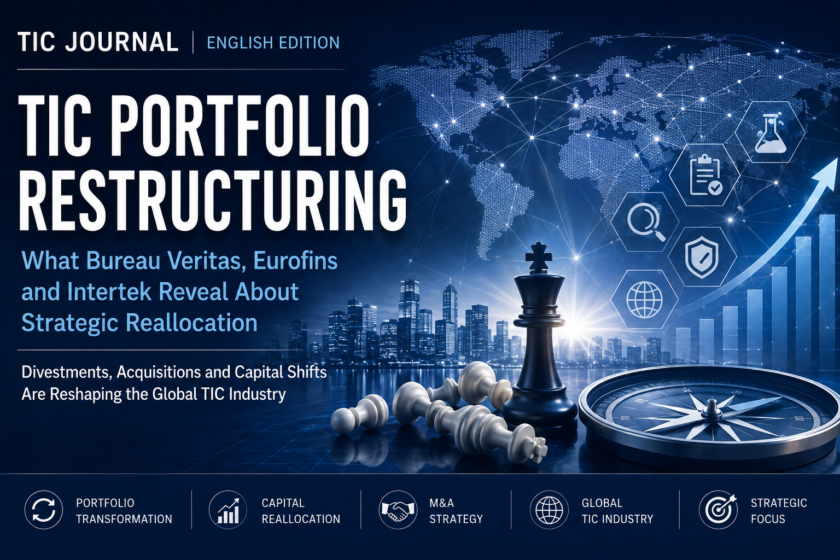
TIC INDUSTRY & PORTFOLIO STRATEGY
Across the global TIC industry, the disposal and acquisition of assets are taking place at the same time.
Bureau Veritas is considering the sale of its Oil & Petrochemicals and Coal testing and inspection business. Eurofins is divesting its Electrical & Electronics testing business. EQT has agreed terms for the acquisition of Intertek.
At first glance, these appear to be separate transactions. What they have in common, however, is that TIC companies and investors are reassessing which businesses they should own and where capital should be allocated.
This article examines the forces behind this portfolio restructuring and what it may mean for the competitive structure of the TIC industry.
PORTFOLIO TRANSFORMATION
Divestments and Acquisitions Are Reshaping the TIC Industry
In 2026, the global Testing, Inspection and Certification (TIC) industry has seen not only major acquisitions, but also a series of divestments and separations of existing businesses.
On June 30, Bureau Veritas announced that it had entered into exclusive negotiations with Triton Partners regarding the proposed sale of its Oil & Petrochemicals and Coal testing and inspection business.
The business generated approximately €450 million in revenue in 2025 and the proposed transaction is based on an enterprise value of €470 million. The transaction has not yet been completed and is expected to be finalized by the end of the first quarter of 2027, subject to employee representative consultation and customary conditions.
Earlier, in April 2026, Eurofins Scientific signed an agreement to divest its Electrical & Electronics testing business, including MET Labs, to UL Solutions for an enterprise value of €575 million.
In June of the same year, Intertek and EQT announced that they had reached agreement on the terms of a proposed acquisition of Intertek. Unlike the Bureau Veritas and Eurofins transactions, this is not the disposal of a specific business unit, but a major transaction involving the entire global TIC group.
ENGLISH EDITION UPDATE — AUGUST 2026
Since publication of the original Japanese Edition, the Intertek transaction has progressed. On August 6, 2026, the required majorities of shareholders approved the Scheme at the Court Meeting and the related Special Resolution at the General Meeting. The transaction has not yet become effective and remains subject to the remaining conditions, including Court sanction. Completion and delisting should therefore not yet be described as having occurred.
Although the three transactions differ in form, each can be understood as part of a broader effort to reallocate capital, businesses, people, technologies and geographic networks in line with future TIC strategies.
KEY TRANSACTIONS
Key TIC Portfolio Transactions in 2026
BUREAU VERITAS
Proposed Sale of Oil, Petrochemicals and Coal Activities
Bureau Veritas entered into exclusive negotiations with Triton Partners. The business generated approximately €450 million in revenue in 2025 and the contemplated transaction is based on an enterprise value of €470 million.
EUROFINS
Electrical & Electronics Testing Business to UL Solutions
Eurofins signed an agreement to divest its Electrical & Electronics testing business, including MET Labs, for an enterprise value of €575 million. The transaction reflects Eurofins’ strategy of concentrating capital on its core “Testing for Life” activities.
INTERTEK
Recommended Acquisition by EQT
The transaction covers the entire global TIC group. Shareholders approved the Scheme and related resolution on August 6, 2026, but the acquisition remains subject to the remaining conditions and has not yet become effective.
PORTFOLIO ROTATION
1. Why Bureau Veritas Is Considering the Sale of a Mature Business
The business Bureau Veritas is considering selling covers testing and inspection services for Oil & Petrochemicals and Coal.
According to the company’s official announcement, the business operates a global network across multiple countries and generated approximately €450 million in revenue in 2025.
At the same time, Bureau Veritas stated that the business had grown at a lower rate than the Group and was dilutive to the Group’s margin.
In other words, the business is not being considered for sale simply because of its size.
Even a business with meaningful scale and an established customer base may become less compelling to retain if management is seeking to improve the Group’s overall growth profile, margins and capital efficiency.
Under its medium-term LEAP | 28 strategy, Bureau Veritas is actively rotating its business portfolio.
The proposed divestment is positioned as part of a strategy to redeploy capital toward businesses offering higher growth and higher margins.
STRATEGIC POINT
Growth, Margin and Capital Efficiency Matter More Than Revenue Alone
Major TIC companies are increasingly evaluating the value of individual businesses not simply by revenue, but in comparison with the performance and strategic priorities of the broader group.
- Is the growth rate aligned with the Group’s strategy?
- Does the business enhance or dilute margins?
- Does continued investment generate sufficient returns on capital?
- Could the business create greater value under a different owner?
What Can Be Confirmed From Public Information
Some secondary materials have suggested that all proceeds from the proposed sale would be directed toward renewable energy, semiconductors and carbon verification.
That level of specificity is not confirmed in Bureau Veritas’ official announcement.
What the company has officially stated is that it intends to redeploy the proceeds toward higher-growth and higher-margin businesses in line with LEAP | 28.
STRATEGIC FOCUS
2. Eurofins Is Divesting Electrical & Electronics Testing to Sharpen Its Life Sciences Focus
Eurofins’ proposed divestment of MET Labs is different in character from an exit driven by poor business performance.
MET Labs provides safety testing, inspection, certification and global market access support for electrical and electronic products. Its customers include companies in consumer electronics, automotive, telecommunications and industrial sectors.
Eurofins has also stated that the profitability of the business is broadly in line with the Group average.
Despite this, Eurofins chose to divest the business because it has made clear that it intends to concentrate capital on its core Testing for Life capabilities.
This illustrates an important point: even a profitable TIC business can become a candidate for divestment if its strategic fit with the Group’s long-term direction is limited.
How Eurofins Plans to Use the Divestment Proceeds
Strengthening the Balance Sheet
The proceeds may be used for priorities including debt reduction and share buybacks as part of capital structure optimization.
Investment in Laboratories and Owned Sites
Eurofins intends to strengthen facilities and infrastructure supporting its core testing businesses and future demand.
Digitalization and Automation
Capital allocation priorities include next-generation digital solutions, robotics and artificial intelligence development.
M&A in Life Sciences
The company also intends to pursue strategic acquisitions that strengthen its positions in areas including pharmaceuticals, clinical testing, food and environmental testing.
DIFFERENT OWNER, DIFFERENT VALUE
3. The Same TIC Asset Can Have Different Value Under a Different Owner
The Bureau Veritas and Eurofins transactions highlight another important characteristic of the TIC industry.
The strategic value of a testing, inspection or certification business is not necessarily the same for every owner.
A business that is no longer a strategic priority for one group may still be highly attractive to another company or investor.
TIC businesses often possess assets that take considerable time and investment to build, including laboratory networks, accreditations, technical expertise, customer relationships, regulatory knowledge and established market positions.
These capabilities can retain significant value even when the business no longer fits the portfolio strategy of its current parent company.
KEY POINT
In the TIC industry, a divestment does not necessarily mean that the underlying business has lost value. It may instead reflect a change in strategic fit between the business and its current owner.
ASSET VALUE
What Makes TIC Assets Valuable?
Unlike businesses whose value can be replicated primarily through capital investment, TIC operations often depend on accumulated institutional capabilities.
- Accredited laboratories and testing facilities
- Technical personnel and specialist expertise
- Certification and accreditation frameworks
- Long-standing customer relationships
- Regulatory and standards knowledge
- Geographic laboratory and inspection networks
- Established reputation and market credibility
Many of these assets cannot be recreated quickly.
For a buyer seeking to enter a new technical field or geographic market, acquiring an established TIC operation can therefore provide capabilities that would otherwise require years to develop organically.
STRATEGIC BUYERS & FINANCIAL INVESTORS
4. Strategic Buyers and Financial Investors See Different Opportunities
Portfolio restructuring also creates opportunities for different types of buyers.
For strategic TIC companies, acquisitions can provide immediate access to laboratories, accreditations, technologies, customers and geographic markets.
A business that is peripheral to one TIC group may fit directly into the growth strategy of another.
Financial investors may evaluate the same assets differently.
Rather than focusing primarily on integration with an existing TIC network, they may consider whether the business can create greater value as an independent platform, through operational improvement, further acquisitions or future strategic repositioning.
The proposed acquisition of Intertek by EQT illustrates the growing relevance of this perspective at the highest level of the TIC market.
Intertek is not a small specialist laboratory or a non-core division. It is one of the world’s major TIC groups.
The transaction therefore demonstrates that private capital is capable of targeting not only individual TIC assets but also large-scale global TIC platforms.
CAPITAL REALLOCATION
5. Portfolio Restructuring Is Ultimately About Capital Allocation
The common theme behind these transactions is capital allocation.
TIC companies operate across a wide range of markets, including industrial inspection, consumer products, food, pharmaceuticals, environmental testing, automotive, electronics, cybersecurity and sustainability.
However, growth rates, margins, capital requirements and strategic relevance differ significantly across these businesses.
As a result, owning a broad portfolio does not automatically mean that every business should remain within the same corporate group indefinitely.
Management teams must continuously decide where additional capital can generate the greatest strategic and financial value.
PORTFOLIO LOGIC
The question is shifting from “Is this a good business?” to “Is this the right business for us to own?”
This distinction is particularly important in understanding the current wave of TIC portfolio restructuring.
A profitable and established business can still be sold if another area offers stronger growth, higher margins, better strategic alignment or more attractive returns on capital.
SELECTIVE DIVERSIFICATION
6. The TIC Industry Is Moving From Expansion to Selective Diversification
For many years, major TIC groups expanded their portfolios by entering new countries, industries and testing fields through acquisitions.
Scale and diversification remain important advantages.
However, the latest transactions suggest that the next phase of competition may involve not only acquiring new businesses, but also actively reshaping existing portfolios.
This means that M&A strategy in the TIC industry is becoming increasingly two-directional.
- Acquire businesses that strengthen strategic growth areas.
- Divest businesses that no longer fit capital allocation priorities.
Portfolio management is therefore becoming as important as portfolio expansion.
The result may be a TIC industry in which companies become more selective about the capabilities, technologies and markets they choose to own.
IMPACT ON THE TIC INDUSTRY
7. What Portfolio Restructuring Means for the TIC Industry
The recent transactions involving Bureau Veritas, Eurofins and Intertek suggest that competition in the TIC industry is increasingly being shaped not only by market share or geographic expansion, but also by the quality of portfolio allocation.
For major TIC groups, the question is no longer simply how many businesses, laboratories or countries they can add to their networks.
The more important question is whether each business contributes to the Group’s future growth, profitability and strategic positioning.
This could lead to further portfolio rotation across the industry.
Businesses that are mature, less aligned with group strategy or better suited to another owner may become candidates for divestment, while capital is redirected toward areas where future demand and strategic value are expected to be stronger.
At the same time, divested TIC businesses may become acquisition opportunities for other TIC companies, private equity investors or new market entrants.
WHAT COMES NEXT
8. The Next Phase of TIC Competition
The TIC industry continues to benefit from structural demand created by regulation, quality assurance, sustainability requirements, technological change and increasingly complex global supply chains.
However, growth opportunities are not distributed evenly across all TIC markets.
As companies respond to these differences, portfolio strategy is likely to become an increasingly important element of competition.
This does not necessarily mean that TIC groups will become smaller.
Rather, they may become more selective about where they seek scale.
Future industry restructuring may therefore involve a combination of acquisitions, divestments, carve-outs, private equity investment and the creation of new specialist platforms.
The competitive advantage of a TIC company may increasingly depend not only on what it can acquire, but also on what it chooses to retain, develop or sell.
TICNOLOGY JAPAN VIEW
The TIC Industry Is Entering an Era of Portfolio Design
The simultaneous emergence of divestments and acquisitions suggests that the global TIC industry is entering a new phase.
For many years, the growth strategies of major TIC companies were often discussed primarily in terms of expansion: entering new countries, adding laboratories, acquiring specialist capabilities and increasing scale.
That logic remains important. But the recent transactions involving Bureau Veritas, Eurofins and Intertek show that the industry must increasingly be viewed through another lens: portfolio design.
A business does not necessarily lose its value simply because it is sold.
The more important issue is whether that business remains the most appropriate asset for its current owner and whether capital could generate greater value elsewhere.
This is particularly significant in the TIC industry because laboratories, accreditations, technical personnel, customer relationships and regulatory expertise cannot be built overnight.
As a result, assets released through portfolio restructuring may become strategically valuable building blocks for another TIC company or investor.
The future structure of the TIC industry may therefore be shaped not only by consolidation among large groups, but also by the continuous redistribution of laboratories, capabilities, technologies and geographic networks between different owners.
From this perspective, TIC M&A is evolving from a simple pursuit of scale into a more sophisticated process of determining who should own which capabilities, in which markets, and for what strategic purpose.
CONCLUSION
Portfolio Strategy Is Becoming a Core Competitive Capability
The Bureau Veritas, Eurofins and Intertek transactions differ significantly in structure.
Bureau Veritas is considering the divestment of a mature testing and inspection business. Eurofins is selling an established Electrical & Electronics testing operation to concentrate resources on its core Testing for Life activities. Intertek is the subject of a proposed acquisition by EQT involving the entire global group.
Yet all three developments point toward the same structural change.
TIC companies and investors are becoming more deliberate about where capital, technical capabilities and management resources should be allocated.
The next stage of TIC industry development may therefore be defined not simply by consolidation, but by continuous portfolio transformation.
The ability to acquire attractive businesses will remain important. Increasingly, however, the ability to identify which businesses to retain, strengthen, reposition or divest may become just as important.
EDITORIAL NOTE
This English Edition is based on the original TIC Journal article published by TICnology Japan and has been updated to reflect material developments confirmed as of August 2026. The original Japanese Edition remains preserved as the article published at that time.
SOURCE
Original TIC Journal Article
TIC Journal — TICnology Japan: TIC Industry Portfolio Transformation
This article is provided for informational purposes and is based on publicly available information. Transaction status, corporate strategies and other information may change after publication.





コメント