



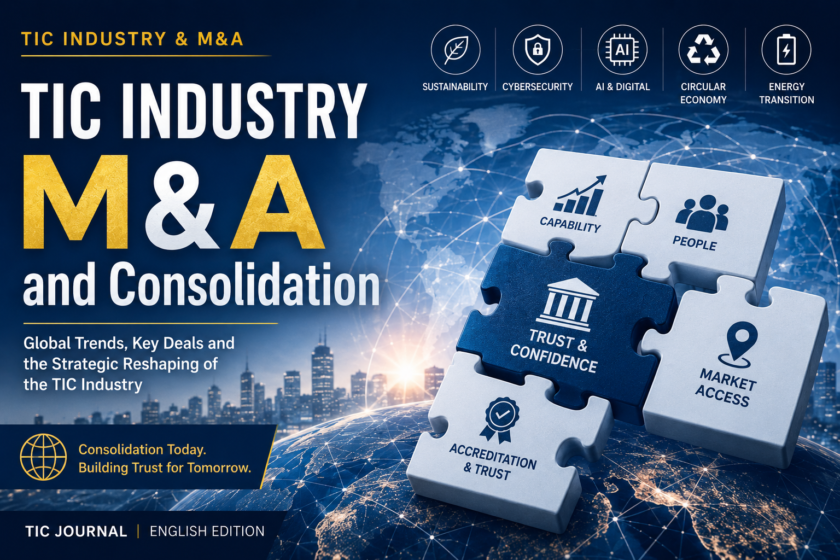
TIC INDUSTRY & M&A
The global Testing, Inspection and Certification (TIC) industry is entering a new phase of consolidation. Major TIC groups are using mergers and acquisitions not only to expand their scale, but also to acquire specialized technical capabilities, skilled professionals, accreditation, customer relationships and access to strategic markets. At the same time, companies from emerging TIC markets, including China, are accelerating their international expansion. The result is a gradual reshaping of the competitive structure of the global TIC industry.
TIC-sector M&A is evolving from a race for scale into a competition for capabilities.
INDUSTRY TRANSFORMATION
The TIC Industry Is Entering an Era of Consolidation
The scope of services required from TIC companies is expanding rapidly.
In addition to traditional product testing, factory inspection and ISO certification, new areas of assessment are emerging in response to environmental regulation, PFAS, recycled materials, cybersecurity, artificial intelligence, food safety, the energy transition and supply-chain information requirements.
Entering these fields quickly requires more than simply installing new equipment. TIC companies need to secure specialist personnel, accreditation, technical expertise, customer relationships and local networks at the same time.
M&A has therefore become more than a means of increasing revenue. It is increasingly an important management strategy for acquiring the capabilities that TIC companies will need in the future.
GLOBAL DEAL
The Proposed Acquisition of Intertek Highlights the Investment Value of TIC
In June 2026, Intertek and EQT announced that they had reached an agreement on a cash acquisition of Intertek by an acquisition company controlled by EQT.
According to the announced terms, Intertek’s equity was valued at approximately £9.4 billion, with an enterprise value of approximately £10.6 billion including debt and other items.
The transaction remains subject to the required shareholder and regulatory approvals and other conditions. It should therefore be described as an agreed acquisition that is progressing through the necessary procedures, rather than as a completed acquisition or completed delisting.
Intertek is one of the world’s major TIC companies, providing testing, inspection, certification and quality assurance services across global markets.
In its announcement, EQT highlighted Intertek’s long-term customer relationships, technical capabilities, specialist workforce and global operating network.
It also identified innovation, digitalization, artificial intelligence, international expansion and additional M&A as potential areas for future investment and growth.
TIC Companies as Trust Infrastructure for Industry and Society
The proposed acquisition of Intertek suggests that investors do not view TIC companies simply as testing businesses.
- Recurring demand supported by regulation and customer requirements
- Barriers to entry created by specialist personnel, equipment, accreditation and operating experience
- Diversified customer bases across industries and geographic markets
- Recurring revenue and cash-flow characteristics
- Growth markets created by new regulations and technologies
TIC businesses create trust between products, companies, transactions and society. The Intertek transaction can therefore be viewed as an example of private equity recognizing TIC as an infrastructure-like industry with long-term growth potential.
GLOBAL EXPANSION
SGS Is Using M&A to Acquire Missing Capabilities
SGS has also pursued an active acquisition strategy across 2025 and 2026.
Its corporate disclosures show acquisitions across a wide range of specialist fields, including environmental services, marine activities, industrial safety, bicycle and e-bike testing, and digital trust.
SGS also completed the acquisition of Applied Technical Services (ATS) in January 2026.
ATS provides specialized testing, inspection, calibration and forensic services in North America. SGS described the acquisition as its largest transaction to date.
By the first half of 2026, SGS had also reported completing 14 additional acquisitions in priority growth areas.
Digital Trust and Sustainability have been positioned as strategically important areas, with capabilities being strengthened in cybersecurity, digital forensics, food and nutrition testing, industrial safety, environmental risk and digital engineering.
What SGS Is Acquiring Through M&A
Capability
Acquisitions provide access to specialist technologies required in growth areas such as environmental services, cybersecurity, food testing and industrial safety.
People
They also provide teams of specialists with expertise in testing methods, standards, regulation, auditing and other technical disciplines.
Market Access
Acquiring an established local organization provides rapid access to existing customers, facilities, brands and sales networks in new countries and regions.
Accreditation and Customer Relationships
Acquisitions can also provide established accreditation scopes, operating records and customer relationships that would otherwise take considerable time to build from the ground up.
Capability + People + Market Access + Accreditation
Building laboratories, recruiting specialists, obtaining accreditation and developing customer relationships organically can take years. M&A can significantly shorten that process.
CHINA PRIVATE SECTOR
Chinese Private TIC Companies Are Moving From Domestic Growth to Global Expansion
Chinese private-sector TIC companies are also expanding their international presence and technical capabilities through acquisitions.
One prominent example is Centre Testing International Group (CTI).
CTI’s 2025 annual report describes how the acquisition of Safety SA in South Africa strengthened its presence in African and Middle Eastern markets.
The company has also expanded its local testing and analytical network in Europe through acquisitions including MIDAC Laboratories in France.
Investor materials published by CTI indicate that acquisition procedures involving Safety SA, Emicert in Greece, Openview and MIDAC Laboratories in France were completed during the second half of 2025 and the businesses were brought into the group’s consolidation scope.
These acquisitions can be understood as supporting Chinese companies expanding overseas while also providing services to local customers, acquiring international verification and certification capabilities, and building regional service networks.
What CTI’s International Expansion Reveals
- Building local service networks to support Chinese companies expanding overseas
- Acquiring customer bases in Europe and Africa
- Strengthening international certification and verification capabilities
- Expanding specialist capabilities in food, environmental, marine and greenhouse-gas-related fields
- Creating technical and customer referral links between overseas laboratories and domestic Chinese operations
SPECIALIZED CAPABILITIES
Domestic Chinese Acquisitions Are Also Filling Capability Gaps
Listed TIC companies within China are also using acquisitions to complement their existing businesses.
In 2025, GRG Metrology & Test acquired a 55% interest in Beijing Jinyuan Dongli Information Technology Evaluation Co., Ltd. The company stated that the acquisition would strengthen its capabilities in software evaluation, network security and data security services.
China Automotive Engineering Research Institute-related testing operations have also pursued acquisitions involving automotive testing capabilities for extreme cold environments.
Extreme cold and snow conditions require specialized testing capabilities for new-energy vehicles, including battery performance, thermal management, driving range, sensors and advanced driver-assistance systems.
These transactions are characterized less by the pursuit of corporate scale itself and more by the acquisition of specialist capabilities that complement existing operations.
Specialist TIC Fields Likely to Become Increasingly Important
- Cybersecurity
- Software evaluation
- AI and digital trust
- PFAS and environmental regulation
- Recycled materials and the circular economy
- Biosafety
- Energy and nuclear-related services
- Extreme-environment testing
STATE-OWNED SECTOR
China’s State-Owned TIC Restructuring Follows a Different Logic
China’s government-related institutions, public-sector entities and local state-owned enterprises hold extensive testing, inspection, metrology and certification capabilities.
The restructuring of state-owned TIC resources therefore cannot be explained solely through conventional corporate acquisitions.
Transactions and restructuring can take multiple forms, including business transfers, capital partnerships, regional cooperation, organizational integration and joint operations.
Because personnel, assets, accreditation, administrative functions and regional jurisdictions may all be involved, these processes can be more complex and more gradual than private-sector M&A.
The increasing role of central state-owned TIC organizations, including China Certification & Inspection Group (CCIC), can be observed. However, currently available official information does not establish a confirmed nationwide policy under which all local institutions will be uniformly consolidated into a single company.
It is therefore more appropriate to understand the current situation as one in which cooperation and functional consolidation among state-owned TIC institutions are progressing by region and field, with the structure and pace varying from case to case.
FIVE DRIVERS
Why M&A Is Accelerating in the TIC Industry
01 — Expansion of Regulatory Scope
PFAS, PPWR, cybersecurity, AI, decarbonization, recycled materials and supply-chain information requirements are creating new forms of assessment demand.
02 — Shortage of Specialist Talent
TIC businesses require professionals who understand standards, regulation, testing methods, auditing and certification.
03 — Globalization of Customers
Customers increasingly expect consistent quality and coordinated support across multiple countries.
04 — Digitalization
Investment is increasingly required in digital trust, AI assessment, LIMS, data management, remote auditing and related technologies.
05 — Scale to Support Continuous Investment
Advanced equipment, accreditation maintenance, personnel development, IT systems and overseas operations all require sustained investment capacity.
The competitive advantage of a TIC company is increasingly determined not only by its size, but by how effectively it combines specialized capabilities, people, accreditation and market access.
MARKET IMPACT
Consolidation Does Not Necessarily Mean the End of Price Competition
It may appear that increasing industry concentration should reduce price competition.
However, companies making acquisitions need to improve utilization of the laboratories, equipment and personnel they acquire and expand the revenue generated by those assets.
As a result, acquiring companies may intensify sales activities after a transaction, potentially increasing competition for existing customers.
In highly specialized fields, however, customers are more likely to evaluate factors beyond price, including accreditation scope, technical capability, turnaround time, regulatory interpretation, international support, data reliability and the ability to provide integrated services.
The market may therefore become increasingly polarized: price competition may continue in more standardized testing services, while specialist expertise commands greater value in advanced testing and advisory services.
POST-MERGER INTEGRATION
Acquisition and Integration Are Two Different Challenges
The most difficult part of M&A is often not signing the acquisition agreement, but integrating the acquired business afterward.
TIC companies face several industry-specific integration challenges.
- Quality management systems differ between laboratories
- Accreditation scopes and accreditation bodies differ
- Report formats and testing procedures may not be standardized
- LIMS and core business systems may differ
- Customer contracts and pricing structures may differ
- Technical personnel may operate under different evaluation systems and corporate cultures
- Brands and sales channels may overlap
Simply placing an acquired company beneath a parent company on an organizational chart does not create genuine synergy.
Post-merger value depends on how far equipment, personnel, sales, quality management, accreditation and IT systems should be integrated — and which specialist capabilities should remain independent.
STRATEGY FOR SPECIALISTS
Strategic Options for Small and Mid-Sized TIC Companies
Industry consolidation does not mean that every small or mid-sized TIC company will ultimately be sold to a larger group.
Build Exceptional Expertise in a Specific Field
Niche testing capabilities that major groups find difficult to develop internally can provide independent organizations with meaningful competitive strength.
Build Networks With Other Laboratories
Rather than owning every piece of equipment internally, TIC companies can collaborate with specialist organizations in Japan and overseas to provide customers with the most appropriate testing and certification structure.
Improve Productivity Through Digitalization
LIMS, quotation management, report generation, customer portals and AI-assisted review can be used to improve operational efficiency.
Become a Partner to Major TIC Companies
A sale is not the only option. Contract testing, joint sales, regional partnerships and technical alliances can also create strategic opportunities.
Connect Overseas TIC Companies With the Japanese Market
Specialist TIC companies can also support Japanese companies operating internationally and overseas TIC companies seeking access to the Japanese market.
TICNOLOGY JAPAN VIEW
The Competitive Axis Is Shifting From Scale to the Combination of Capabilities
M&A activity observed across 2025 and 2026 indicates that the TIC industry is entering a genuine period of restructuring.
However, companies are not pursuing acquisitions and integration for the same reasons.
- Global TIC groups are acquiring specialist technologies, geographic reach and access to growth markets.
- Chinese private-sector companies are expanding their overseas networks and international service capabilities.
- China’s state-owned sector is restructuring fragmented infrastructure functions.
- Small and mid-sized TIC companies can create distinctive positions through specialization, partnerships and digitalization.
Future competitiveness will not be determined by revenue scale alone.
The value of a TIC company will increasingly depend on which specialist capabilities it possesses, which markets it covers, which organizations it can work with, and how comprehensively it can solve customer challenges. The combination of these capabilities will become a defining competitive factor.
CONCLUSION
TIC Industry Consolidation Is a Reconfiguration of the Ability to Deliver Trust
The essence of M&A is not simply to reduce the number of companies in the market.
It is about reorganizing specialist capabilities and networks so that TIC organizations can respond to new regulations, technologies, industries and geographic markets.
TICnology Japan will continue to analyze the global TIC market, M&A activity, specialist institutional networks, and regulatory and technological developments to support decision-making by Japanese companies and TIC industry participants.
TIC-sector consolidation is ultimately about rebuilding and combining the capabilities required to provide trust.
SOURCE & EDITORIAL BASIS
Source & Editorial Basis
Original Japanese Edition:
TIC Journal — TIC Industry M&A and Consolidation
This English Edition is based on the original Japanese article published by TICnology Japan.
The Japanese Edition remains as originally published. For this English Edition, subsequent developments and publicly available information were reviewed and updated where necessary, while maintaining the original article’s analytical framework and perspective.
The English Edition therefore serves as an updated international version of the original TIC Journal article, reflecting relevant developments available as of the time of English publication.
TIC Journal | English Edition is published by TICnology Japan and provides analysis of developments in the global Testing, Inspection and Certification industry.



コメント