



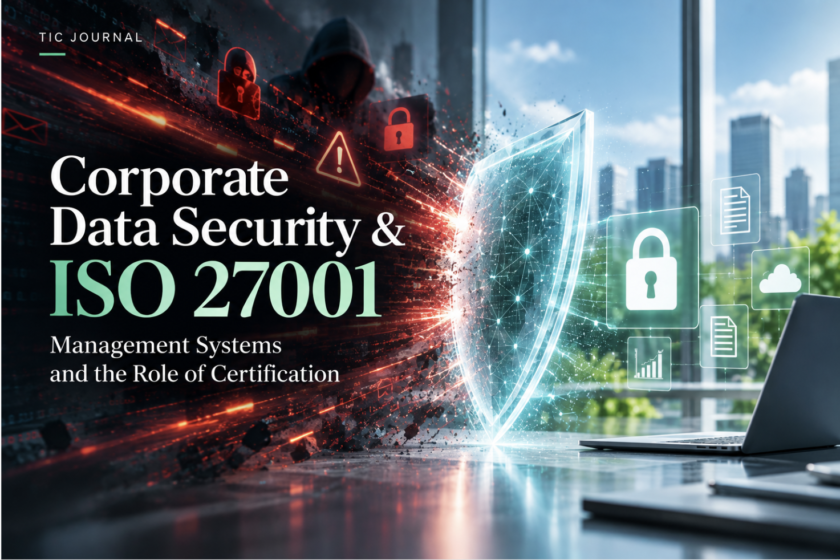
Today, cyberattacks are becoming increasingly sophisticated, including those that exploit artificial intelligence (AI). Businesses face a changing information security landscape, with increasingly convincing phishing messages, unauthorized access, ransomware-related system disruptions, and the exposure of confidential information. These risks affect organizations across industries and of all sizes.
As cyber threats become an everyday business risk, organizations need more than technical safeguards. They also need a structured approach to identifying, managing, and continually improving their responses to information security risks.
An internationally recognized foundation for this approach is ISO/IEC 27001, the standard for information security management systems.
Drawing on official information from the International Electrotechnical Commission (IEC) and the International Organization for Standardization (ISO), this article explains the ISO 27001 framework, the role of independent certification, and its practical value in managing data security risks.
What Is ISO 27001?
ISO/IEC 27001 is an international standard jointly developed by ISO and IEC. It specifies requirements for an information security management system (ISMS).
The standard provides a framework for organizations to identify information security risks, implement appropriate measures, maintain their management systems, and continually improve their effectiveness.
Information security is built around three fundamental principles:
Confidentiality
Ensuring that information is accessible only to authorized individuals. Examples include restricting access to customer records and proprietary business information.
Integrity
Maintaining the accuracy and completeness of information. Examples include preventing unauthorized changes to laboratory test results and contractual records.
Availability
Ensuring that information and systems remain accessible when needed. Examples include data backups and business continuity measures.
Organizations assess their information security risks against these principles and implement measures appropriate to their operations, size, and business environment.
What Does ISO 27001 Require?
ISO 27001 establishes requirements for managing information security across an organization.
These include leadership responsibilities, information security policies, risk assessments, selection of security controls, employee awareness and training, internal audits, and continual improvement.
Annex A of ISO/IEC 27001:2022 contains 93 information security controls, organized into four categories: organizational, people, physical, and technological controls.
Examples include:
- Access control: Managing who can access information and information systems.
- Management of technical vulnerabilities: Identifying software vulnerabilities and responding according to risk.
- Supplier security: Defining and managing information security responsibilities involving external providers.
- Incident management: Establishing procedures to respond to data breaches and cyber incidents.
- Information backup: Protecting important information against disruption, loss, or damage.
Organizations select appropriate controls based on their risk assessments and document their applicability, implementation status, and justification for inclusion or exclusion in a Statement of Applicability (SoA).
What Does ISO 27001 Certification Assess?
ISO 27001 certification involves an independent assessment by a third-party certification body to determine whether an organization’s ISMS conforms to the requirements of the standard.
Certification audits examine more than documented policies and procedures. They also consider risk assessment records, the implementation and operation of security controls, internal audits, and corrective and improvement activities.
Following initial certification, organizations generally undergo periodic surveillance audits and recertification audits on a three-year cycle.
The requirements relating to the competence, consistency, and impartiality of certification bodies conducting ISMS audits are addressed in ISO/IEC 27006-1:2024.
Independent certification therefore provides an additional level of assessment beyond an organization’s own evaluation of its information security management system.
ISO 27001 Certification and Data Breach Risks
ISO 27001 certification can support organizations in establishing and maintaining a structured approach to managing information security risks, including those associated with data breaches.
For example, when a new software vulnerability is discovered, an established ISMS can help an organization identify affected systems, assess potential impacts, implement corrective measures, and verify the actions taken.
In its official guidance, ISO identifies several potential benefits of implementing ISO/IEC 27001, including improved resilience against cyberattacks, preparedness for emerging threats, and protection of information confidentiality, integrity, and availability.
However, certification audits primarily evaluate the management system and its operation. They serve a different purpose from technical security testing designed to identify vulnerabilities in individual systems.
What Certification Demonstrates
ISO 27001 certification provides independent assurance regarding an organization’s information security management system within its defined scope. It does not guarantee that every cyberattack or data breach will be prevented. Ongoing technical safeguards, monitoring, and continual improvement remain essential.
What Should Businesses Check When Evaluating ISO 27001 Certification?
ISO 27001 certification can also serve as a useful reference when evaluating the information security management practices of suppliers, business partners, and outsourced service providers.
Key considerations include:
Certificate Validity
Is the certification currently valid?
Certification Scope
Are the relevant business locations, activities, and services included within the certified scope?
Vulnerability Management
Are processes in place to identify security vulnerabilities and implement appropriate responses?
Information Access and Protection
Are customer data and confidential information subject to appropriate access controls?
Incident Response
Are procedures established for reporting, managing, and responding to information security incidents?
Evaluating both certification status and actual management practices enables businesses to develop a more informed understanding of their partners’ information security capabilities.
TICNOLOGY JAPAN VIEW
Continual Improvement: The Key to Maximizing the Value of ISO 27001 Certification
Information security is no longer simply a matter of managing operational risks. It has become an important factor influencing the confidence of customers, business partners, and other stakeholders.
ISO 27001 certification provides an internationally recognized mechanism for independent assessment of an organization’s information security management system. It is therefore a valuable means of demonstrating a structured commitment to information security.
Nevertheless, certification does not guarantee protection against every cyberattack or data breach. Certification audits assess the management system and its implementation rather than providing comprehensive technical assurance for every individual system. In addition, certification may apply only to specified locations, operations, or services.
These characteristics highlight the importance of going beyond maintaining the management system established at the time of certification. Organizations must regularly reassess risks and continually improve their technical safeguards and operational practices in response to changing threats and business conditions. This principle of continual improvement is fundamental to ISO 27001.
For businesses assessing their suppliers and partners, the same principle applies. Certification status should be considered alongside its scope, actual operational practices, and evidence of continual improvement.
The true value of ISO 27001 certification lies in combining the credibility of independent third-party assessment with a management system that continually improves the effectiveness of information security.
Continued investment in information security, supported by credible third-party certification, can strengthen business confidence, reinforce organizational resilience, and contribute to new commercial opportunities and long-term competitiveness.
Sources and References
- International Electrotechnical Commission (IEC), “ISO/IEC 27001:2022 — Information security, cybersecurity and privacy protection — Information security management systems — Requirements.”
- International Electrotechnical Commission (IEC), “ISO/IEC 27006-1:2024 — Information security, cybersecurity and privacy protection — Requirements for bodies providing audit and certification of information security management systems — Part 1: General.”
- International Organization for Standardization (ISO), “ISO/IEC 27001 — Information Security Management Systems.”
- International Organization for Standardization (ISO), “ISO/IEC 27001: What’s New in IT Security?”
This article is based on official publicly available information published by IEC and ISO.



コメント