



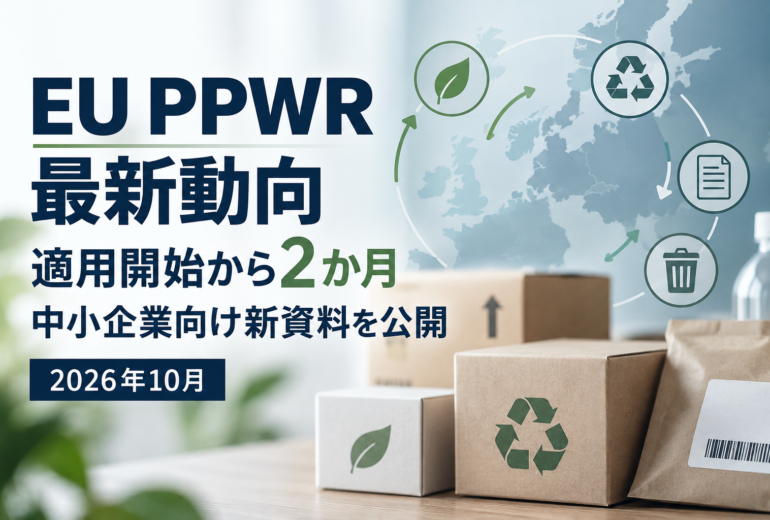
Around two months have passed since the EU’s new packaging rules under the Packaging and Packaging Waste Regulation (PPWR) began to apply on 12 August 2026.
With the Regulation now in application, the focus for businesses is shifting from understanding what the PPWR requires to managing those requirements in practice across products, packaging and distribution models.
Against this background, on 19 October 2026 the European Commission published a new factsheet for small businesses entitled “Packaging and Packaging Waste Regulation (PPWR) and small businesses: What do I need to know?”
The new material addresses practical aspects of PPWR implementation, including responsibility for the collection and recycling of packaging waste, registration and reporting in EU Member States, and measures intended to reduce administrative burdens for smaller businesses.
Why has the Commission published this information around two months after the PPWR began to apply?
This article looks at the current stage of PPWR implementation and the key points businesses should continue to monitor as the regulatory framework develops.
1. Why Has the Commission Published New Information Now?
The PPWR entered into force on 11 February 2025 and began to apply on 12 August 2026.
Its requirements, however, follow different implementation timelines. Some requirements apply from 2026, while others are scheduled to take effect progressively in 2028, 2030 and beyond.
Businesses are therefore moving into the operational stage: identifying which requirements apply to their packaging and incorporating those requirements into their actual compliance processes.
The European Commission has also been publishing guidance, FAQs and other materials to support businesses and EU Member States in implementing the PPWR.
The new factsheet for small businesses forms part of this process. It focuses in particular on areas that can create practical and administrative burdens for smaller businesses, including registration, reporting and financial responsibilities relating to packaging waste.
The PPWR has entered its operational phase. Businesses now need to monitor new implementation information and review their compliance approach as the framework continues to develop.
2. What Is the PPWR?
The Packaging and Packaging Waste Regulation (PPWR) establishes EU-wide rules for packaging and packaging waste.
It replaces the previous Packaging and Packaging Waste Directive (PPWD) and is intended to further harmonise packaging rules across the EU while reducing packaging waste and promoting a more circular use of resources.
Its scope extends beyond boxes and containers used directly for products. Product packaging, individual packaging, outer packaging and transport packaging may all fall within the PPWR framework when placed on the EU market.
| Area | Key Requirements |
|---|---|
| Substances in packaging | Requirements relating to heavy metals and PFAS in food-contact packaging, among others |
| Recyclability | Requirements aimed at improving packaging recyclability |
| Recycled content | Recycled-content requirements for certain plastic packaging |
| Packaging minimisation | Measures to reduce unnecessary packaging and empty space |
| Labelling | Labelling requirements relating to packaging materials and waste sorting |
| Reuse | Reuse requirements and targets for certain packaging formats |
| Collection and recycling | Responsibilities relating to packaging after it becomes waste |
The PPWR therefore covers the packaging lifecycle from how packaging is designed and what it contains to how it is managed after use.
One of the areas highlighted in the Commission’s new information for small businesses concerns responsibility for packaging once it has been placed on the market and subsequently becomes waste.
This brings us to Extended Producer Responsibility.
3. What Is Extended Producer Responsibility?
One of the key topics addressed in the new material is Extended Producer Responsibility (EPR).
The basic concept is straightforward. Once a product has been sold and used, its packaging eventually becomes waste.
EPR places responsibility on producers for aspects of managing that packaging after use, including the financial contribution required for collection and recycling.
Businesses therefore need to consider more than packaging materials and substance content. Practical questions include which EU Member States the products are sold in, who is responsible for packaging registration, what information must be reported, and how the relevant collection and recycling costs are managed.
PPWR compliance therefore extends from the characteristics of the packaging itself to responsibilities that arise after the packaging has been placed on the market.
4. Reduced Administrative Burdens for Smaller Producers
An important part of the Commission’s latest information concerns measures that take business size into account.
Under the PPWR, simplified reporting provisions apply in certain circumstances to producers that make available for the first time in a Member State less than 10 tonnes of packaging or packaged products during a calendar year.
The European Commission also explains how administrative burdens for smaller producers can be reduced in areas such as registration procedures, record keeping, inspections and audits.
The 10-tonne threshold is an important reference point when considering simplified reporting and administrative burdens for smaller producers. The applicable arrangements should also be checked against the system in the Member State where the products are marketed.
5. Why Does the Country of Sale Matter?
The PPWR applies across the EU, while packaging registration and waste-management systems have historically been operated at Member State level.
In practice, businesses therefore need to consider the common PPWR requirements together with the packaging registration and EPR arrangements operating in the Member States where their products are marketed.
A company selling products in several EU countries may, for example, need to manage EU-wide PPWR requirements while also checking registration and packaging-waste obligations in each relevant Member State.
The PPWR also provides for further harmonisation of registration and reporting arrangements across the EU.
For businesses, separating information that can be managed centrally across the EU from procedures that must be addressed at Member State level can make ongoing compliance easier to manage.
6. Changes to Authorised Representative Requirements
The Commission’s latest information also addresses authorised representatives.
In the EPR context, an authorised representative can act as the designated representative for meeting producer-responsibility requirements in another EU Member State.
This can be relevant, for example, where a business supplies packaged products directly into another Member State.
The European Commission has proposed changes to these requirements as part of efforts to reduce administrative burdens for smaller businesses.
The related legislative changes are currently under consideration at EU level. Businesses selling packaged products across several Member States should therefore continue to monitor developments in this area.
7. What Should Companies Exporting to the EU Check?
For companies exporting products to the EU, packaging is part of the product flow entering the EU market and therefore needs to be considered within the PPWR compliance process.
A practical starting point is to identify the packaging used for products supplied to the EU. This may include product packaging, individual packaging, outer packaging and transport packaging.
For each packaging component, relevant information such as material, weight, composition, intended use and substance content should be organised.
The supply chain should then be mapped. Who imports the product into the EU? Who sells it? In which Member States is it marketed?
These factors can affect the roles and procedures that apply under the PPWR.
Sharing this information with EU importers, distributors and other relevant business partners can help clarify who is responsible for each part of the compliance process.
Combining packaging information with a clear understanding of the supply chain makes it easier to identify what information the exporter should prepare, what should be confirmed with business partners and where additional action may be required.
8. What Should Businesses Be Checking Now?
The PPWR is already in its implementation phase.
Businesses that have already established their initial compliance approach should therefore compare their current processes with the latest regulatory and implementation information.
STEP 1 — Identify packaging supplied to the EU
Map product packaging, individual packaging, outer packaging and transport packaging.
STEP 2 — Organise packaging information
Review materials, weight, components, intended use and relevant substance information.
STEP 3 — Map markets and the supply chain
Identify the Member States where products are marketed and the relevant importers, distributors and other business partners.
STEP 4 — Review current compliance
Compare requirements currently in application with the company’s existing compliance arrangements.
STEP 5 — Check Member State requirements
Review applicable registration, reporting, collection and recycling arrangements in the relevant markets.
STEP 6 — Monitor upcoming changes
Track new Commission information and requirements scheduled to apply in later phases.
The practical objective is to keep the company’s compliance approach aligned with regulatory developments rather than treating PPWR compliance as a one-time exercise.
9. PPWR Has Entered the Monitoring and Operational Phase
The PPWR began to apply in August 2026 and businesses are now operating within the new regulatory framework.
At the same time, further requirements will apply progressively, while the European Commission continues to publish guidance, FAQs and practical implementation information, including the latest material for small businesses.
The next challenge for businesses is therefore to monitor these developments and assess how they affect their own products, packaging, markets and supply chains.
When new information or regulatory changes emerge, companies should consider whether their current approach remains appropriate and whether additional information, testing, assessment or changes in responsibilities with business partners are required.
PPWR compliance is increasingly becoming an ongoing process of monitoring regulatory developments, assessing their business impact and selecting the appropriate response.
TICNOLOGY JAPAN VIEW
The PPWR began to apply in August 2026, and businesses are already operating under the new framework.
The next phase is continuous monitoring. Companies need to follow information published by the European Commission and individual Member States and assess how each development affects their products, packaging, markets and supply chains.
From there, businesses can determine whether their current approach should continue, whether additional information, testing or assessment is needed, or whether responsibilities with business partners should be adjusted. These decisions should be made with a balanced view of regulatory risk, cost and operational impact.
The most appropriate compliance approach can vary by product, market and supply chain. Maintaining an effective PPWR programme therefore requires companies to evaluate regulatory developments against their own circumstances and update their approach when necessary.
TICnology Japan supports companies with PPWR and other international product and environmental regulations by monitoring regulatory developments, assessing business impact, structuring compliance strategies and selecting appropriate specialist service providers where required.
References
- European Commission, “Packaging and Packaging Waste Regulation (PPWR) and small businesses: What do I need to know?”
- European Commission, “Extended Producer Responsibility for Packaging for Small Businesses”
- European Commission, “Guidance Document for Regulation (EU) 2025/40 on Packaging and Packaging Waste”
- Regulation (EU) 2025/40 on Packaging and Packaging Waste
Information current as of: 22 October 2026
This article is provided for general informational purposes. For specific PPWR compliance decisions, companies should review the latest EU legislation, European Commission guidance and FAQs, the packaging concerned, the relevant supply chain and the applicable requirements in the EU Member States where products are marketed.


コメント