



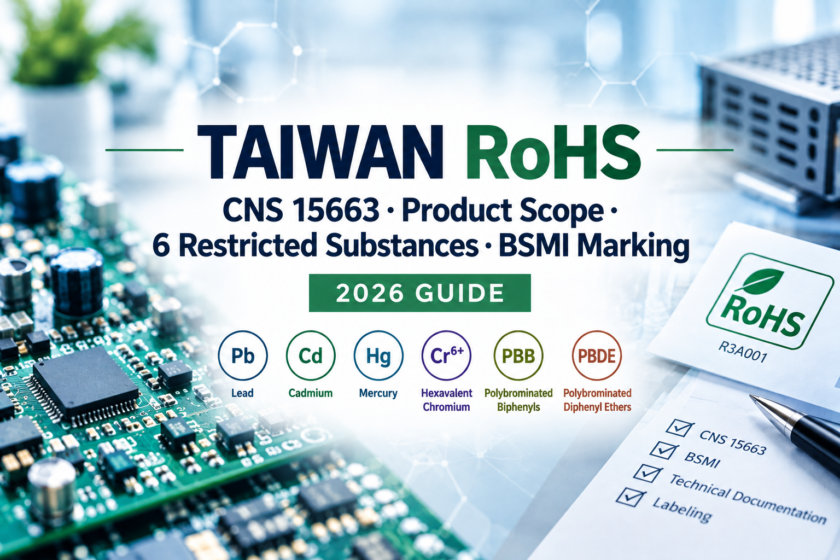
When exporting electrical and electronic products to Taiwan, one of the key regulatory frameworks to consider is commonly referred to as “Taiwan RoHS.”
In Taiwan, the Bureau of Standards, Metrology and Inspection (BSMI) incorporates the national standard CNS 15663, Guidance to Reduction of the Restricted Chemical Substances in Electrical and Electronic Equipment, into the inspection requirements for designated electrical and electronic products.
CNS 15663 addresses six restricted substances—lead (Pb), mercury (Hg), cadmium (Cd), hexavalent chromium (Cr6+), PBB and PBDE—and Section 5 specifies requirements for marking the presence conditions of restricted substances.
For products intended for the Taiwan market, a practical compliance review can be organized as follows:
Product scope → Applicable standards → Six restricted substances → CNS 15663 marking → BSMI commodity inspection
This article explains the key requirements of Taiwan RoHS in 2026, including product scope, restricted substances and concentration limits, CNS 15663 marking requirements, BSMI labeling and the practical documentation companies should prepare before placing products on the Taiwan market.
1. What Is Taiwan RoHS?
“Taiwan RoHS” is a commonly used term for requirements concerning restricted substances in electrical and electronic products in Taiwan.
Two elements are particularly important when understanding the framework: Taiwan’s national standard CNS 15663 and the commodity inspection system administered by the Bureau of Standards, Metrology and Inspection (BSMI).
For designated electrical and electronic products, BSMI may specify CNS 15663 Section 5 requirements together with applicable safety, EMC and other inspection standards.
Companies supplying products to Taiwan should therefore review the following points as part of the same compliance process:
- Whether the product is subject to mandatory BSMI inspection
- Which inspection standards apply to the product
- Whether CNS 15663 requirements apply
- What marking and technical documentation are required
2. Which Products Are Covered?
The first step in Taiwan RoHS compliance is to determine whether the product falls within the scope of Taiwan’s mandatory commodity inspection requirements.
BSMI publishes inspection requirements for designated electrical and electronic products. The applicable standards, inspection procedures and CNS 15663 requirements are determined according to the relevant product category and BSMI announcement.
In practice, companies can structure the review as follows:
For multifunction or combined-function products, the applicable inspection and certification requirements should be reviewed according to the characteristics and functions of the specific product.
The starting point for Taiwan RoHS compliance is to determine whether CNS 15663 applies to the specific product. The applicable BSMI announcement and inspection standards should be checked for each product category.
3. The Six Restricted Substances under Taiwan RoHS
CNS 15663 addresses the following six restricted substances:
| Restricted Substance | Symbol / Abbreviation | Reference Concentration Value |
|---|---|---|
| Lead | Pb | 0.1 wt% (1,000 ppm) |
| Mercury | Hg | 0.1 wt% (1,000 ppm) |
| Cadmium | Cd | 0.01 wt% (100 ppm) |
| Hexavalent Chromium | Cr6+ | 0.1 wt% (1,000 ppm) |
| Polybrominated Biphenyls | PBB | 0.1 wt% (1,000 ppm) |
| Polybrominated Diphenyl Ethers | PBDE | 0.1 wt% (1,000 ppm) |
CNS 15663 also provides exclusions for specified applications. Companies should therefore review the composition of components and materials together with any applicable exclusion provisions.
4. How Does Taiwan RoHS Differ from EU RoHS?
Understanding the regulatory structure is useful when comparing Taiwan RoHS with the EU RoHS framework.
EU RoHS establishes restrictions on the use of specified hazardous substances in electrical and electronic equipment.
In Taiwan, CNS 15663 Section 5 is incorporated into BSMI commodity inspection requirements for designated products, with particular emphasis on marking the presence conditions of restricted substances.
A distinctive feature is the marking used when one or more restricted substances exceed the applicable reference concentration value.
| Example | Meaning |
|---|---|
| RoHS | Restricted substances do not exceed the applicable reference concentration values, excluding applicable exclusions |
| RoHS(Pb) | Lead exceeds the reference concentration value in one or more relevant units |
| RoHS(Cd, Cr6+, PBB) | The listed substances exceed the reference concentration values in one or more relevant units |
This approach to declaring and marking restricted-substance content is an important feature of Taiwan’s framework.
5. What Is the CNS 15663 Presence Condition Marking?
Section 5 of CNS 15663 specifies how the presence conditions of the six restricted substances are to be disclosed for the relevant units or components of a product.
BSMI examples include units such as circuit boards, motors, switches, power cords and housings, with the presence condition of each restricted substance indicated for each unit.
| Marking | Meaning |
|---|---|
| ○ | The percentage content of the restricted substance does not exceed the reference concentration value |
| Exceeding 0.1 wt% / 0.01 wt% | The restricted substance exceeds the applicable reference concentration value |
| - | The item corresponds to an applicable exclusion under CNS 15663 |
The presence condition information may be displayed on the product body, packaging, label or instruction manual.
It may also be disclosed through a website. When this approach is used, the website address should be clearly indicated on the product body, packaging, label or instruction manual in accordance with the applicable requirements.
6. “RoHS” Marking on the Commodity Inspection Mark
For products to which CNS 15663 applies, information concerning the restricted substances is displayed together with the applicable commodity inspection identification information.
or
RoHS(Pb)
RoHS indicates that, excluding applicable exclusions under CNS 15663, the restricted substances do not exceed the reference concentration values.
RoHS(XX,XX) identifies the restricted substance or substances exceeding the applicable reference concentration values.
Companies supplying products to Taiwan should therefore consider the final labeling and commodity inspection mark requirements together with component information and supporting technical data.
7. How Should the Six Substances Be Assessed?
Taiwan RoHS compliance requires companies to understand the presence conditions of the six restricted substances in the relevant components and materials of the product.
A practical information flow can be organized as follows:
Depending on the product and supply chain, relevant information may include supplier declarations, material information and testing or analytical data.
BSMI’s RoHS application guidance also provides for the preparation of RoHS-related technical documentation and declarations concerning the marking of restricted-substance presence conditions.
Organizing information at the level of relevant units, components and materials helps companies prepare the required CNS 15663 disclosure and supporting documentation efficiently.
8. What Documentation Is Required for BSMI Procedures?
BSMI provides guidance for preparing RoHS-related applications for electrical and electronic products.
Depending on the applicable application and inspection procedure, documentation may include:
- Declaration of the presence conditions of restricted substances
- Diagram or information showing the location of the required marking
- RoHS-related technical documentation
- Other documentation required for the applicable BSMI application
For products that have already obtained the relevant certificate, changes to components, marking information, product structure or series models may also require documentation according to the nature of the change.
For this reason, companies can improve efficiency by coordinating RoHS information management and BSMI application documentation from an early stage of market preparation.
9. What Happens When a Reference Concentration Value Is Exceeded?
BSMI provides a marking method for cases where a restricted substance exceeds the applicable reference concentration value under CNS 15663.
Examples include RoHS(Pb) or RoHS(Cd, Cr6+, PBB), with the relevant substance or substances identified in parentheses.
Section 5 of CNS 15663 also provides a method for indicating such conditions in the restricted-substance presence condition table.
A practical review should follow the sequence: reference concentration values → applicable exclusions → presence condition marking → product-specific BSMI inspection requirements.
This marking mechanism is one of the key characteristics to understand when preparing electrical and electronic products for the Taiwan market.
10. Who Handles BSMI Compliance?
For imported products, the Taiwan-side importer or other eligible applicant generally handles the applicable commodity inspection and certification procedures.
Overseas manufacturers and suppliers should organize the information needed to support the Taiwan-side applicant, including:
- Product specifications
- Model information
- Component and material composition
- Information on the six restricted substances
- Relevant RoHS testing or analytical information
- Technical documentation
- Marking and labeling information
For products incorporating components from multiple suppliers, establishing a system to consolidate RoHS information at the product level can support both initial applications and subsequent change management.
11. Practical Pre-Export Checklist for Taiwan
STEP 1 — Identify the Product
Organize the product name, model, specifications, functions and intended use.
STEP 2 — Check the BSMI Product Scope
Determine whether the product is subject to mandatory commodity inspection based on its product classification, C.C.C. Code and applicable BSMI requirements.
STEP 3 — Confirm the Applicable Standards
Identify the applicable safety, EMC, CNS 15663 and other specified standards.
STEP 4 — Organize Components and Materials
Identify relevant units such as circuit boards, cables, housings, motors and other major components.
STEP 5 — Confirm the Six Restricted Substances
Collect relevant supplier information and testing or analytical data.
STEP 6 — Review Applicable Exclusions
Determine whether any relevant CNS 15663 exclusion provisions apply.
STEP 7 — Prepare the Presence Condition Marking
Organize the restricted-substance information in accordance with CNS 15663 Section 5.
STEP 8 — Prepare BSMI Documentation
Prepare the applicable declarations, marking location information and technical documentation.
STEP 9 — Confirm the Commodity Inspection Mark
Review the applicable RoHS or RoHS(XX,XX) information and other required marking elements.
STEP 10 — Establish Change Management
Review the regulatory impact when components, materials, suppliers, models or other relevant product information change.
Taiwan RoHS compliance involves more than managing information on the six restricted substances. Companies should connect product scope, applicable standards, component and material information, CNS 15663 marking and BSMI procedures as part of a single compliance process.
For overseas manufacturers and suppliers, organizing RoHS information for components and materials at an early stage and sharing it with the Taiwan-side importer or applicant can support efficient decisions on testing, technical documentation and marking requirements.
The same product substance information can also support RoHS and product environmental compliance in multiple markets, including Taiwan, the EU, China and Korea.
Building a common information foundation for products, components and materials can turn market-specific compliance activities into a more efficient global market-access process.
TICnology Japan supports companies by structuring applicable regulatory requirements and required information, and selecting appropriate specialist service providers for regulatory research, testing, analysis and certification support according to the needs of each project.
TICnology Japan can help structure the applicable requirements and identify appropriate testing, analysis and certification support for your project.
References
- Taiwan Bureau of Standards, Metrology and Inspection, “RoHS Requirements”
- Taiwan Bureau of Standards, Metrology and Inspection, “Guidance for RoHS Documentation and Applications for Electrical and Electronic Products”
- Taiwan Bureau of Standards, Metrology and Inspection, “Inspection Requirements for Commodities Subject to Mandatory Inspection”
- Taiwan National Standard CNS 15663, “Guidance to Reduction of the Restricted Chemical Substances in Electrical and Electronic Equipment”
- Taiwan Bureau of Standards, Metrology and Inspection, “Declaration of the Presence Conditions of the Restricted Substances Marking”
Information current as of October 21, 2026.
This article provides general information on Taiwan’s product compliance framework. Companies should review the latest BSMI announcements, product scope, C.C.C. Code, applicable inspection standards, product specifications and application-specific requirements when preparing products for the Taiwan market.




コメント